
« PREVIOUS ENTRY
It’s Alive! My piece on Pleo in Wired magazine
NEXT ENTRY »
Sending good vibes to Heather Gold
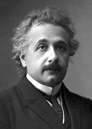
Scientists have long known that being rich makes you live longer. And rich people are often famous. But does fame itself help you live longer? It’s hard to test this, because it’s difficult to find the right sort of data. You’d need to find a large corpus of data about dead people that contains several individuals who suddenly and without warning became famous.
Except it turns out there actually is a good dataset for that: Winners of the Nobel Prize. Two economists at the University of Warwick looked at all the nominees and winners for physics and chemistry between 1901 and 1950 — a total of 528 scientists. They controlled for the monetary effect of winning a Nobel, since it comes with a cash prize large enough to affect one’s health.
The result? Those who won Nobel prizes lived up to two years longer, on average, than those who’d “merely” been nominated. As Andrew Oswald, one of the two economists, said in a press release:
Professor Oswald said: “Status seems to work a kind of health-giving magic. Once we do the statistical corrections, walking across that platform in Stockholm apparently adds about 2 years to a scientist’s life-span. How status does this, we just don’t know.”
I read their paper, which is freely online here, and found out something else interesting: Apparently, the only research anyone’s done similar to this studied the longevity effects of winning an Oscar — another example of a prize that is suddenly conferred, and which abruptly teleports the winner into a quantum ring of fame far removed from their fellow actors. Anyway, it turns out the previous studies here are pretty inconclusive, because they diametrically contradict one another: One found that Oscar winners live 3.6 years longer than mere nominees, while the other found Oscar winners live 3.6 less.
Pretty fascinating area of work, eh? Now what I want to see is some comparison charts of how various activities stack up as life-extending activities. By which I mean, is it better to cut out fatty foods or, y’know, win a Nobel Prize? Because this would clearly change our to-do lists.
I'm Clive Thompson, the author of Smarter Than You Think: How Technology is Changing Our Minds for the Better (Penguin Press). You can order the book now at Amazon, Barnes and Noble, Powells, Indiebound, or through your local bookstore! I'm also a contributing writer for the New York Times Magazine and a columnist for Wired magazine. Email is here or ping me via the antiquated form of AOL IM (pomeranian99).
ECHO
Erik Weissengruber
Vespaboy
Terri Senft
Tom Igoe
El Rey Del Art
Morgan Noel
Maura Johnston
Cori Eckert
Heather Gold
Andrew Hearst
Chris Allbritton
Bret Dawson
Michele Tepper
Sharyn November
Gail Jaitin
Barnaby Marshall
Frankly, I'd Rather Not
The Shifted Librarian
Ryan Bigge
Nick Denton
Howard Sherman's Nuggets
Serial Deviant
Ellen McDermott
Jeff Liu
Marc Kelsey
Chris Shieh
Iron Monkey
Diversions
Rob Toole
Donut Rock City
Ross Judson
Idle Words
J-Walk Blog
The Antic Muse
Tribblescape
Little Things
Jeff Heer
Abstract Dynamics
Snark Market
Plastic Bag
Sensory Impact
Incoming Signals
MemeFirst
MemoryCard
Majikthise
Ludonauts
Boing Boing
Slashdot
Atrios
Smart Mobs
Plastic
Ludology.org
The Feature
Gizmodo
game girl
Mindjack
Techdirt Wireless News
Corante Gaming blog
Corante Social Software blog
ECHO
SciTech Daily
Arts and Letters Daily
Textually.org
BlogPulse
Robots.net
Alan Reiter's Wireless Data Weblog
Brad DeLong
Viral Marketing Blog
Gameblogs
Slashdot Games

