
« PREVIOUS ENTRY
Scientists can’t get sloth to move
NEXT ENTRY »
The death of privacy, and the next generation gap
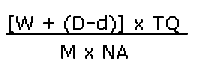
Is this the suckiest week of the year? It ought to be, according to Cliff Arnall, a professor at Cardiff University. Arnall, an expert on seasonal depression, has authored the equation you see above, which calculates the “most depressing day of the year”. This year, it was January 23rd — Tuesday. Last year, the equation offered up Jan. 24th as the buzzkiller of the year, so this week is clearly haunted.
The equation works thusly: You apply it to each day of the year, and calculate the values. W stands for weather, D for your level of debt, d for your monthly salary; T is “time since Christmas” and Q for the amount of time since you last failed in an attempt to quit smoking. (Smoking? Well, Arnall’s British.) M is your “low motivational levels” and NA is the “need to take action.” The gist of it is, if the weather is really bad, you have high debt, and it’s been a while since your last failed attempt to stop smoking, the numerator gets high, boosting the day’s depression rating. If your motivation and ability to take action plummets, the divisor shrinks, creating the same effect. As MSNBC reports:
Arnall found that, while days technically get longer after Dec. 21, cyclonic weather systems take hold in January, bringing low, dark clouds to Britain. Meanwhile, the majority of people break their healthy resolutions six to seven days into the new year, and even the hangers-on have fallen off the wagon, torn off the nicotine patches and eaten the fridge empty by the third week. Any residual dregs of holiday cheer and family fun have kicked the bucket by Jan. 24.
“Following the initial thrill of New Year’s celebrations and changing over a new leaf, reality starts to sink in,” Arnall said. “The realization coincides with the dark clouds rolling in and the obligation to pay off Christmas credit card bills.”
Obviously, the variables in the equation are personalized, so Arnall’s proclamation of Jan. 23 as the singlemost depressing day might not hold true for you. More obviously yet, this doesn’t seem to be even vaguely scientific since Arnall doesn’t offer any data to back up his equation, his association with Cardiff University seems to be ungoogleable, and the whole thing smells like a PR endeavour.
I still don’t care. I am such a sucker for pseudo-precise equations that purport to clarify everyday life.
I'm Clive Thompson, the author of Smarter Than You Think: How Technology is Changing Our Minds for the Better (Penguin Press). You can order the book now at Amazon, Barnes and Noble, Powells, Indiebound, or through your local bookstore! I'm also a contributing writer for the New York Times Magazine and a columnist for Wired magazine. Email is here or ping me via the antiquated form of AOL IM (pomeranian99).

ECHO
Erik Weissengruber
Vespaboy
Terri Senft
Tom Igoe
El Rey Del Art
Morgan Noel
Maura Johnston
Cori Eckert
Heather Gold
Andrew Hearst
Chris Allbritton
Bret Dawson
Michele Tepper
Sharyn November
Gail Jaitin
Barnaby Marshall
Frankly, I'd Rather Not
The Shifted Librarian
Ryan Bigge
Nick Denton
Howard Sherman's Nuggets
Serial Deviant
Ellen McDermott
Jeff Liu
Marc Kelsey
Chris Shieh
Iron Monkey
Diversions
Rob Toole
Donut Rock City
Ross Judson
Idle Words
J-Walk Blog
The Antic Muse
Tribblescape
Little Things
Jeff Heer
Abstract Dynamics
Snark Market
Plastic Bag
Sensory Impact
Incoming Signals
MemeFirst
MemoryCard
Majikthise
Ludonauts
Boing Boing
Slashdot
Atrios
Smart Mobs
Plastic
Ludology.org
The Feature
Gizmodo
game girl
Mindjack
Techdirt Wireless News
Corante Gaming blog
Corante Social Software blog
ECHO
SciTech Daily
Arts and Letters Daily
Textually.org
BlogPulse
Robots.net
Alan Reiter's Wireless Data Weblog
Brad DeLong
Viral Marketing Blog
Gameblogs
Slashdot Games

