
« PREVIOUS ENTRY
Is this sea creature real or CGI?
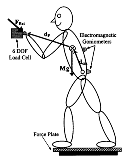
Everyone knows that if you don’t want to screw up your back, you should lift heavy objects by bending your knees, not your back. But 20 per cent of all workplace back injuries in North America are caused not by lifting — but by pushing and pulling heavy weights. So what’s the correct way to pull or push?
For years, scientists assumed that the forces at play in your body when you push or pull never spin out of control they way they do with lifting. Whenever they measured these forces, they didn’t seem big enough to cause serious damage.
But recently, two biomechanists — Kevin Granata of Virginia Polytechnic Institute and Bradford Bennett of the University of Virginia — realized the previous experiments had left something out: The “cocontraction” of muscles, which is the body’s use of opposing muscle groups to stabilize the body. So they wired up a bunch of experimental subjects with gonimeters to measure muscle activity, and had them push levers at various force levels: 15 per cent of their body mass, 30 per cent, or as hard as they could push. The results? As Cognitive Daily reports:
… when cocontraction was factored in, the force on the spine increased by as much as 400 percent, depending on the height of the handle and the amount of force applied. Cocontraction was greatest when participants bent lower to push on the handle, as they would when pushing the heaviest loads. In these cases, stress on the spine matches stress in lifting tasks and may be what leads to the most injuries.
They also note that as the amount of pushing force increases, the vertical component of the pushing force also increases, because the volunteers need the corresponding downward force on their feet to gain traction. This makes a pushing action more like a lifting action, again potentially increasing the chance of injury.
Ow. I don’t think their study formally concludes the best way to push or pull, but it’s a cool area to study. It also makes me feel sore just reading about it, because I’ve had a hair-trigger back ever since grade 13 in high school, when I worked at a lighting store and screwed myself up ferociously by lifting superheavy chandeliers with one hand while wiring them into the ceiling with the other. I had been an otherwise perfectly healthy 18 years old, but a year of that sort of work left me so bent over with pain that I had to lie in bed for four days recovering. “If I’d known you were a cripple,” my boss told me as I limped home, “I wouldn’t have hired you.” Nice.
A really sad note: Granata, a co-author of this study, was one of the professors who died in the recent Virginia Tech shootings.
I'm Clive Thompson, the author of Smarter Than You Think: How Technology is Changing Our Minds for the Better (Penguin Press). You can order the book now at Amazon, Barnes and Noble, Powells, Indiebound, or through your local bookstore! I'm also a contributing writer for the New York Times Magazine and a columnist for Wired magazine. Email is here or ping me via the antiquated form of AOL IM (pomeranian99).
ECHO
Erik Weissengruber
Vespaboy
Terri Senft
Tom Igoe
El Rey Del Art
Morgan Noel
Maura Johnston
Cori Eckert
Heather Gold
Andrew Hearst
Chris Allbritton
Bret Dawson
Michele Tepper
Sharyn November
Gail Jaitin
Barnaby Marshall
Frankly, I'd Rather Not
The Shifted Librarian
Ryan Bigge
Nick Denton
Howard Sherman's Nuggets
Serial Deviant
Ellen McDermott
Jeff Liu
Marc Kelsey
Chris Shieh
Iron Monkey
Diversions
Rob Toole
Donut Rock City
Ross Judson
Idle Words
J-Walk Blog
The Antic Muse
Tribblescape
Little Things
Jeff Heer
Abstract Dynamics
Snark Market
Plastic Bag
Sensory Impact
Incoming Signals
MemeFirst
MemoryCard
Majikthise
Ludonauts
Boing Boing
Slashdot
Atrios
Smart Mobs
Plastic
Ludology.org
The Feature
Gizmodo
game girl
Mindjack
Techdirt Wireless News
Corante Gaming blog
Corante Social Software blog
ECHO
SciTech Daily
Arts and Letters Daily
Textually.org
BlogPulse
Robots.net
Alan Reiter's Wireless Data Weblog
Brad DeLong
Viral Marketing Blog
Gameblogs
Slashdot Games

