
As most connoisseurs of whale trivia know, all “toothed” whales echolocate — they hunt underwater prey via reflected sound waves. In contrast, all baleen whales — which hunt krill by straining them through seive-like mandibles — do not echolocate. Why the difference?
Marine evolutionary biologists have long assumed it’s because toothed whales dive down deep to hunt prey at night, whereas baleen whales stay near the surface. Since it’s so insanely pitch-black down there, the toothed whales had to evolve echolocation merely to be able to navigate.
For years, this explanation made perfect sense. Still, the biologists were puzzled by one unanswered question: How did the toothed whales know there was food down below?
Because they followed the squid. Many squid rise up to the ocean surface during the night, and plunge down deep during the day. In a recent paper, David Lindberg — the UC Berkeley professor of integrative biology — used fossil records of ancient whales and squid to argue that the toothed whales probably followed the squid down deeper and deeper until they realized there’s a massive buffet of squid kicking around in the ocean’s basement. At which point they also were like, damn, we’re gonna need us some echolocation to fully harvest this squid bonanza.
As a story in Science Daily reports:
Lindberg and Pyenson propose that whales first found it possible to track these hard-shelled creatures in surface waters at night by bouncing sounds off of them, an advantage over whales that relied only on moonlight or starlight.
This would have enabled whales to follow the cephalopods as they migrated downwards into the darkness during the day. Today, the largest number of squid hang out during the day at about 500 meters below the surface, though some go twice as deep. During the night, however, nearly half the squid are within 150 meters of the surface.
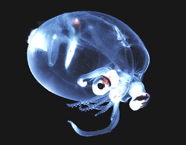
Squid: Noble pistons in the engine of marine evolution.
I'm Clive Thompson, the author of Smarter Than You Think: How Technology is Changing Our Minds for the Better (Penguin Press). You can order the book now at Amazon, Barnes and Noble, Powells, Indiebound, or through your local bookstore! I'm also a contributing writer for the New York Times Magazine and a columnist for Wired magazine. Email is here or ping me via the antiquated form of AOL IM (pomeranian99).

ECHO
Erik Weissengruber
Vespaboy
Terri Senft
Tom Igoe
El Rey Del Art
Morgan Noel
Maura Johnston
Cori Eckert
Heather Gold
Andrew Hearst
Chris Allbritton
Bret Dawson
Michele Tepper
Sharyn November
Gail Jaitin
Barnaby Marshall
Frankly, I'd Rather Not
The Shifted Librarian
Ryan Bigge
Nick Denton
Howard Sherman's Nuggets
Serial Deviant
Ellen McDermott
Jeff Liu
Marc Kelsey
Chris Shieh
Iron Monkey
Diversions
Rob Toole
Donut Rock City
Ross Judson
Idle Words
J-Walk Blog
The Antic Muse
Tribblescape
Little Things
Jeff Heer
Abstract Dynamics
Snark Market
Plastic Bag
Sensory Impact
Incoming Signals
MemeFirst
MemoryCard
Majikthise
Ludonauts
Boing Boing
Slashdot
Atrios
Smart Mobs
Plastic
Ludology.org
The Feature
Gizmodo
game girl
Mindjack
Techdirt Wireless News
Corante Gaming blog
Corante Social Software blog
ECHO
SciTech Daily
Arts and Letters Daily
Textually.org
BlogPulse
Robots.net
Alan Reiter's Wireless Data Weblog
Brad DeLong
Viral Marketing Blog
Gameblogs
Slashdot Games

