
« PREVIOUS ENTRY
Scientists program a computer that understands knock-knock jokes
NEXT ENTRY »
How squid helped whales evolve echolocation

What’s the best way to memorize material? If you want to remember it for a few days, the best way is “cramming” — studying the material over and over again in one long sustained session. But if you want to recall material for years to come, don’t cram — because according to a new experiment, cramming hurts your long-term memory.
Educators have long known that “overlearning” and “massing” — studying material repeated in long, late-night sessions — works pretty well in the short term. Students who cram historically do better on tests than those who don’t. But scientists didn’t know whether overlearning helped you remember things years down the line.
So recently, the psychologists Doug Rohrer and Harold Pahsler decided to figure it out. They took two groups of people and had one of them cram for a test, studying material 10 times in a row — while another group only studied the stuff only 5 times in a row. When both groups took tests immediately after studying, sure enough, cramming worked: The “overlearners” achieved three perfect scores on average each, compared to only one perfect score for the ones who’d studied less often. But then Rohrer and Pahsler gave the groups the same tests — four weeks later. This time there was no difference in performance. The advantage from cramming had evaporated.
Okay, so let’s say you actually do want to remember things for the long-haul. How should you study? Rohrer and Pahsler tested that too. In their next experiment, they gave people crazily different study regimens — some of the subjects studied material repeatedly every 5 minutes (a classic “cramming” regimen), while others reviewed material only every month or so. Then they tested everyone six months after their study sessions. Bingo: The ones who did best had studied the material merely once a month.
Assuming their findings — which are published here in a PDF paper — hold water, the implications for education are enormous. That’s because most high-school and college courses are designed to reward cramming. They’re setting up students to forget things. Even textbooks are designed with overlearning in mind, as the authors point out:
This apparent ineffectiveness of overlearning and massing is troubling because these two strategies are fostered by most mathematics textbooks. In these texts, each set of practice problems consists almost entirely of problems relating solely to the immediately preceding material. The concentration of all similar problems into the same practice set constitutes massing, and the sheer number of similar problems within each practice set guarantees overlearning.
So how would you re-engineer textbooks and classes to emphasize long-term recall? You could, they suggest, have teachers intersperse topics throughout the year, instead of forcing kids to focus on them pell-mell for a few days, never to return again. Textbooks could be rewritten so that lessons are also intermingled: “For example, a lesson on parabolas would be followed by a practice set with the usual number of problems, but only a few of these problems would relate to parabolas. Other parabola problems would be distributed throughout the remaining practice sets.”
This is seriously fascinating stuff.
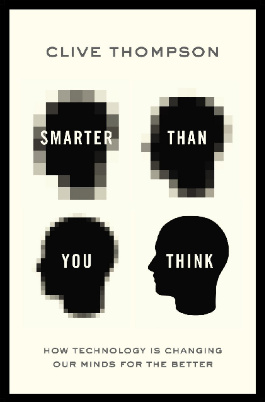
I'm Clive Thompson, the author of Smarter Than You Think: How Technology is Changing Our Minds for the Better (Penguin Press). You can order the book now at Amazon, Barnes and Noble, Powells, Indiebound, or through your local bookstore! I'm also a contributing writer for the New York Times Magazine and a columnist for Wired magazine. Email is here or ping me via the antiquated form of AOL IM (pomeranian99).
ECHO
Erik Weissengruber
Vespaboy
Terri Senft
Tom Igoe
El Rey Del Art
Morgan Noel
Maura Johnston
Cori Eckert
Heather Gold
Andrew Hearst
Chris Allbritton
Bret Dawson
Michele Tepper
Sharyn November
Gail Jaitin
Barnaby Marshall
Frankly, I'd Rather Not
The Shifted Librarian
Ryan Bigge
Nick Denton
Howard Sherman's Nuggets
Serial Deviant
Ellen McDermott
Jeff Liu
Marc Kelsey
Chris Shieh
Iron Monkey
Diversions
Rob Toole
Donut Rock City
Ross Judson
Idle Words
J-Walk Blog
The Antic Muse
Tribblescape
Little Things
Jeff Heer
Abstract Dynamics
Snark Market
Plastic Bag
Sensory Impact
Incoming Signals
MemeFirst
MemoryCard
Majikthise
Ludonauts
Boing Boing
Slashdot
Atrios
Smart Mobs
Plastic
Ludology.org
The Feature
Gizmodo
game girl
Mindjack
Techdirt Wireless News
Corante Gaming blog
Corante Social Software blog
ECHO
SciTech Daily
Arts and Letters Daily
Textually.org
BlogPulse
Robots.net
Alan Reiter's Wireless Data Weblog
Brad DeLong
Viral Marketing Blog
Gameblogs
Slashdot Games

