
« PREVIOUS ENTRY
A possible explanation for “email apnea”
NEXT ENTRY »
LaRouche report calls me a “degenerate writer”
Two years ago, I wrote a column for Wired News called “The Joy of Sucking” — about the subtle pleasures of totally screwing up in a video game. It wasn’t just pulling that out of my hat. It was based on a study by Niklas Ravaja at MIND Labs, who wired up a bunch of gamers with biosensors and found that they gave off strong pleasure signals whenever they died in the game Super Monkey Ball.
Well, Ravaja is at it again — and this time he checked for players’ reactions to killing others, and dying, in a first-person shooter. The results? Apparently the act of killing other people causes enormous strain on us; however, we actually enjoy getting shot to death. As Brandon Erickson summarizes it:
“… instead of joy resulting from victory and success, wounding and killing the opponent elicited anxiety, anger, or both.” In addition, “death of the player’s own character…appear[s] to increase some aspects of positive emotion.” This latter finding the authors believe may result from the temporary “relief from engagement” brought about by character death.
That latter argument makes sense to me. When I’m in a really intense firefight in a game, I’m a total wreck, emotionally. Sure, it feels good to vanquish my foes, but sometimes it’s just nice to get a break, and dying is — among, uh, other things — certainly a break.
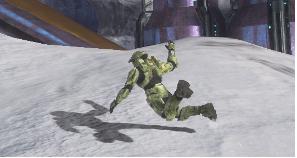
Part of this has to do with the intriguing aesthetic question of precisely how the first-person-shooter represents the player after the moment of death. Multiplayer Halo online offers my personal favorite death vignettes. The instant you die, the game shifts to a third-person camera perspective and follows your body as it slumps to the ground or, more often, goes pinwheeling through the air.
This sudden switch in camera angle — from first person to third person — is, in essence, a classic out-of-body experience, of exactly the sort people describe in near-death experiences. And much like real-life near-death experiences, it tends to suffuse me with a curiously zen-like feeling. The emotional narrative goes like this: During the gameplay, I’ll be desperately fighting for my life, ducking behind pillars, firing spastically, and synaesthetically wincing each time I take gunfire. Just when I think I’m safe, I’ll turn a corner, and whoa — find myself face-to-face with another opponent who slams me with a surprise punch, killing me instantly. The final attack will give me one final jolt of amygladaic shock, and then …
… hey, I’m dead, and my body is floating through the air, and I’m watching myself just sort of tumble around lazily, like a ragdoll.
It’s amazingly peaceful.
(Thanks to Brandon for this one!)
I'm Clive Thompson, the author of Smarter Than You Think: How Technology is Changing Our Minds for the Better (Penguin Press). You can order the book now at Amazon, Barnes and Noble, Powells, Indiebound, or through your local bookstore! I'm also a contributing writer for the New York Times Magazine and a columnist for Wired magazine. Email is here or ping me via the antiquated form of AOL IM (pomeranian99).
ECHO
Erik Weissengruber
Vespaboy
Terri Senft
Tom Igoe
El Rey Del Art
Morgan Noel
Maura Johnston
Cori Eckert
Heather Gold
Andrew Hearst
Chris Allbritton
Bret Dawson
Michele Tepper
Sharyn November
Gail Jaitin
Barnaby Marshall
Frankly, I'd Rather Not
The Shifted Librarian
Ryan Bigge
Nick Denton
Howard Sherman's Nuggets
Serial Deviant
Ellen McDermott
Jeff Liu
Marc Kelsey
Chris Shieh
Iron Monkey
Diversions
Rob Toole
Donut Rock City
Ross Judson
Idle Words
J-Walk Blog
The Antic Muse
Tribblescape
Little Things
Jeff Heer
Abstract Dynamics
Snark Market
Plastic Bag
Sensory Impact
Incoming Signals
MemeFirst
MemoryCard
Majikthise
Ludonauts
Boing Boing
Slashdot
Atrios
Smart Mobs
Plastic
Ludology.org
The Feature
Gizmodo
game girl
Mindjack
Techdirt Wireless News
Corante Gaming blog
Corante Social Software blog
ECHO
SciTech Daily
Arts and Letters Daily
Textually.org
BlogPulse
Robots.net
Alan Reiter's Wireless Data Weblog
Brad DeLong
Viral Marketing Blog
Gameblogs
Slashdot Games

