
« PREVIOUS ENTRY
Study: Gamers actually enjoy dying in first-person-shooters
NEXT ENTRY »
Why solitary workers can be faster workers
This is beyond delightful! The LaRouche PAC report — “The Noosphere vs. The Blogosphere: Is The Devil in Your Laptop?” — refers to me as a “degenerate writer”, “infantile”, and a “disgruntled family man”.
Apparently the political action committee of Lydon Larouche — an economist, political activist, and prolific conspiracy theorist — decided to fund a report on various sourges of digital life, including blogs, Wikipedia, and video games. (PDF copy here.) As you might imagine, the section on video games argues that video games are training kids to become such bloodthirsty psychopaths — so thoroughly desensitized to death — that they are inexorably drawn to suicide.
Their proof? My video game columns at Wired News! The report writers stitch together horrified reactions to my columns on Halo suicide bombings and the infamous Super Columbine Massacre RPG, in a bouquet of prose so garishly purple it reads as if it had been written by a Victorian sexual anthropologist. I don’t even know where to start quoting; it’s all so spectacularly wonderful! So I’ll just excerpt the segment below at length, and let it speak for itself.
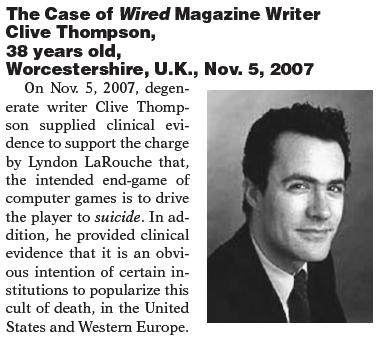
I should point out that their research is so dreadful that the errors begin in the header opening up their section on me, where they report that I live in “Worcestershire, U.K.” I also love that picture, which — in addition to clearly depicting my homicidal/suicidal degeneracy and familial dissatisfaction — they appear to have stolen, without attribution, from the web site of the Knight Science Journalism Fellowships.
This is the best thing I’ve read in, like, seven years or something. And who knows? Given that just yesterday I blogged about the aesthetic pleasure of dying in Halo 3, maybe they’re right!
Forthwith:
The Case of Wired Magazine Writer Clive Thompson, 38 years old Worcestershire, U.K., Nov. 5, 2007
On Nov. 5, 2007, degenerate writer Clive Thompson supplied clinical evidence to support the charge by Lyndon LaRouche that, the intended end-game of computer games is to drive the player to suicide. In addition, he provided clinical evidence that it is an obvious intention of certain institutions to popularize this cult of death, in the United States and Western Europe. In his enraged screed, titled, “Suicide Makes Sick Sense After Playing Halo 3,” Thompson wrote, “I used to find it hard to fully imagine the mindset of a terrorist. That is, until I played Halo 3 online, where I found myself adopting — with great success — terrorist tactics. Including a form of suicide bombing.” The infantile Thompson whines that he “sucks” at Halo 3, played on Bill Gates’s Xbox live, because he has a wife, and kid, and therefore only gets “maybe an hour with Halo on a good day.”
But, Thompson proclaims, therefore, he has learned to kill superior opponents by charging them, while being shot, and throwing a grenade at them at the last moment, to kill, “from beyond the grave.” “It was after pulling this maneuver a couple of dozen times that it suddenly hit me: I had, quite unconsciously, adopted the tactics of a suicide bomber — or a kamikaze pilot. It’s not just that I’m willing to sacrifice my life to kill someone else. It’s that I’m exploiting the psychology of asymmetrical warfare.
“For me,” the disgruntled family man continued, “dying will not penalize me in the way it penalizes them, because I have almost no chance of improving my state. I might as well take people down with me. Or to put it another way: The structure of Xbox Live creates a world composed of two classes — haves and have-nots. And, just as in the real world, some of the disgruntled have-nots are all too willing to toss their lives away — just for the satisfaction of momentarily halting the progress of the haves. Since the game instantly resurrects me, I have no real dread of death in Halo 3.” On the subject of suicide, Thompson concludes, that “something about playing the game gave me an ‘aha’ moment that I’d never had before: an ability to feel, in whatever tiny fashion, the strategic logic and emotional calculus behind the act.”
In another Wired magazine article, by the same Thompson, titled “I, Columbine Killer,” he revels in the game “Columbine Massacre RPG,” a game created to simulate the Columbine massacre! He writes, “I barrel into the Columbine High School cafeteria, pull down the fire alarm, and the kids erupt into chaos. Then I pull out my Savage-Springfield 12-gauge pump-action, which I’ve sawed off to 26 inches for maximum lethality. A jock stumbles across my path: With one blast, he lies dead on the floor. ‘This is what we’ve always wanted to do!’ hollers my fellow killer, Dylan Klebold. ‘This is awesome!”’
This game, as can be observed, places the player in the shoes of satanic gamers’ “folk heroes” Eric Harris and Dylan Klebold. What’s the end of the game? Thompson can’t wait to tell you: “As the school shootings wind up, your avatar commits suicide in the library alongside Harris.
The game cuts to real-life photographs of the killers’ dead bodies, taken from security cameras in the schools.”[9]
I'm Clive Thompson, the author of Smarter Than You Think: How Technology is Changing Our Minds for the Better (Penguin Press). You can order the book now at Amazon, Barnes and Noble, Powells, Indiebound, or through your local bookstore! I'm also a contributing writer for the New York Times Magazine and a columnist for Wired magazine. Email is here or ping me via the antiquated form of AOL IM (pomeranian99).

ECHO
Erik Weissengruber
Vespaboy
Terri Senft
Tom Igoe
El Rey Del Art
Morgan Noel
Maura Johnston
Cori Eckert
Heather Gold
Andrew Hearst
Chris Allbritton
Bret Dawson
Michele Tepper
Sharyn November
Gail Jaitin
Barnaby Marshall
Frankly, I'd Rather Not
The Shifted Librarian
Ryan Bigge
Nick Denton
Howard Sherman's Nuggets
Serial Deviant
Ellen McDermott
Jeff Liu
Marc Kelsey
Chris Shieh
Iron Monkey
Diversions
Rob Toole
Donut Rock City
Ross Judson
Idle Words
J-Walk Blog
The Antic Muse
Tribblescape
Little Things
Jeff Heer
Abstract Dynamics
Snark Market
Plastic Bag
Sensory Impact
Incoming Signals
MemeFirst
MemoryCard
Majikthise
Ludonauts
Boing Boing
Slashdot
Atrios
Smart Mobs
Plastic
Ludology.org
The Feature
Gizmodo
game girl
Mindjack
Techdirt Wireless News
Corante Gaming blog
Corante Social Software blog
ECHO
SciTech Daily
Arts and Letters Daily
Textually.org
BlogPulse
Robots.net
Alan Reiter's Wireless Data Weblog
Brad DeLong
Viral Marketing Blog
Gameblogs
Slashdot Games

