
« PREVIOUS ENTRY
Why solitary workers can be faster workers
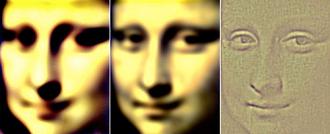
For hundreds of years, art critics have mused over why the Mona Lisa’s smile seems so mysterious. Now the Harvard neurobiologist Margaret Livingstone has a fascinating answer: It’s because Da Vinci painted her face in colors that play tricks on the eye.
Livingstone’s work has long examined the way that different cells in the visual system process different types of information — such as form, color, depth and movement. When she analyzed the Mona Lisa, she found that Da Vinci painted her smile almost completely in low spatial frequencies, and these are best picked up in your peripheral vision. The result, as she notes on her web site, is a nifty illusion:
These three images — [pictured above!] — show her face filtered to show selectively lowest (left) low (middle) and high (right) spatial frequencies.
So when you look at her eyes or the background, you see a smile like the one on the left, or in the middle, and you think she is smiling. But when you look directly at her mouth, it looks more like the panel on the right, and her smile seems to vanish. The fact that the degree of her smile varies so much with gaze angle makes her expression dynamic, and the fact that her smile vanishes when you look directly at it, makes it seem elusive.
It’s somewhat like the way rods in the eye are more numerous in the periphery of our retinas — so the best way to see a faint star in the night sky is to look slightly to the side of it. Either way, this is really cool science.
Cooler than the actual Mona Lisa, really. When I visited the painting a few year ago, I found the experience incredibly underwhelming, because the painting is so ferociously guarded by security devices: A velvet rope preventing you from coming closer than 20 feet, storm troopers with tasers, and, worst of all, a plastic box that produces reflections of light so garish that they destroy any effect Da Vinci was trying to make. Seriously — I get a more moving artistic experience when I look at a low-rez gif of the painting on Flickr. Walter Benjamin would be rolling in his grave.
(Thanks to David Dobbs for this one!)
I'm Clive Thompson, the author of Smarter Than You Think: How Technology is Changing Our Minds for the Better (Penguin Press). You can order the book now at Amazon, Barnes and Noble, Powells, Indiebound, or through your local bookstore! I'm also a contributing writer for the New York Times Magazine and a columnist for Wired magazine. Email is here or ping me via the antiquated form of AOL IM (pomeranian99).
ECHO
Erik Weissengruber
Vespaboy
Terri Senft
Tom Igoe
El Rey Del Art
Morgan Noel
Maura Johnston
Cori Eckert
Heather Gold
Andrew Hearst
Chris Allbritton
Bret Dawson
Michele Tepper
Sharyn November
Gail Jaitin
Barnaby Marshall
Frankly, I'd Rather Not
The Shifted Librarian
Ryan Bigge
Nick Denton
Howard Sherman's Nuggets
Serial Deviant
Ellen McDermott
Jeff Liu
Marc Kelsey
Chris Shieh
Iron Monkey
Diversions
Rob Toole
Donut Rock City
Ross Judson
Idle Words
J-Walk Blog
The Antic Muse
Tribblescape
Little Things
Jeff Heer
Abstract Dynamics
Snark Market
Plastic Bag
Sensory Impact
Incoming Signals
MemeFirst
MemoryCard
Majikthise
Ludonauts
Boing Boing
Slashdot
Atrios
Smart Mobs
Plastic
Ludology.org
The Feature
Gizmodo
game girl
Mindjack
Techdirt Wireless News
Corante Gaming blog
Corante Social Software blog
ECHO
SciTech Daily
Arts and Letters Daily
Textually.org
BlogPulse
Robots.net
Alan Reiter's Wireless Data Weblog
Brad DeLong
Viral Marketing Blog
Gameblogs
Slashdot Games

