
« PREVIOUS ENTRY
$6 million euro robot can make coffee
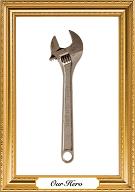
Can you fix things that break in your household? Probably not. Our schools systematically stream “smart” people away from working with their hands, and I think that’s a huge problem for the US, on pretty much every level — commercially, globally, intellectually and spiritually, really.
My latest column in Wired magazine is on the stands now, and it tackles this precise problem. There’s a copy of it on the Wired web site, and one archived below — but of course you should also immediately drop whatever you’re doing and buy a physical copy of Wired, then fill out the subcription card too, heh.
By the way, if you like this column then you’ll love Matthew Crawford’s essay “Shop Class as Soulcraft”, which appeared in The Atlantic Monthly in 2006. I discovered it while doing my research, and wound up interviewing Crawford for my piece. He’s working on an entire book about the demise of America’s prowess with tools, and judging by how superb his essay was, his book will rock with hurricane force, I suspect.
How DIYers Just Might Revive American Innovation
by Clive ThompsonWhat a mess. I’m sitting on the floor of my apartment, surrounded by electronic parts, a cigar box, a soldering gun, and stray bits of wire. I’m trying to build my own steampunk-style clock — hacking a couple of volt meter dials to display hours and minutes. It’ll look awesome when it’s done.
If it ever gets done — I keep botching the soldering. A well-soldered joint is supposed to look like a small, shiny volcano. My attempts look like mashed insects, and they crack when I try to assemble the device.
Why am I so inept? I used to do projects like this all the time when I was a kid. But in high school, I was carefully diverted from shop class when the administration decided I was college-bound. I stopped working with my hands and have barely touched a tool since.
As it turns out, this isn’t a problem just for me — it’s a problem for America. We’ve lost our Everyman ability to build, maintain, and repair the devices we rely on every day. And that’s making it harder to solve the country’s nastiest problems, like oil dependence, climate change, and global competitiveness.
The decay has been rapid. Only a few decades ago, most serious adults were expected to be fluent in basic mechanics. If your car or stove or radio broke down, you opened it up and fixed it. “Magazines like Popular Mechanics in the ’40s and ’50s would publish projects like an automated pig-feeding trough, and they assumed you had the tools and skills to make it,” says Dale Dougherty, editor and publisher of Make magazine.
But as we migrated to an information economy, those skills began to seem as quaint as, well, mechanical clocks. America’s bright future, we were assured, wasn’t industrial. It was in the hands of “symbolic analysts” — folks who sat at desks and thought for a living. In the ’90s, the rise of the Internet sent this post-mechanical age into a sort of giddy overdrive. Remember Nicholas Negroponte urging everyone to “move bits, not atoms”?
But when we stop working with our hands, we cease to understand how the world really works.
You see this on a personal level. If you can’t get under the hood of the gadgets you buy, you’re far more liable to believe the marketing hype of the corporations that sell them. When things break, you toss them and buy new ones; you accept your role as a mere consumer. “I think it makes you more passive as an individual,” says Matthew Crawford, a former motorcycle repair-shop owner (and postdoctoral fellow in cultural studies) who’s writing a book on the demise of mechanical aptitude in America.
It might even screw up our brains. Neuroscientists have shown that working with your hands exercises different parts of your cerebrum than sitting and cogitating. Ever wonder why Detroit isn’t producing 100-mpg cars? One reason might be that the engineers there spend all their time tinkering with CAD software — developing design concepts in a purely virtual sense. They aren’t ripping open cars to see what’s possible, the way those amateur ultra-mileage Prius hackers do (some of whom, by the way, have modded their hybrids to get 100 mpg).
I’d argue there are even larger political effects of our post-atom age. Take the epidemic of corroded highways and collapsing bridges. The basic mechanics of how bridges and roadbeds work are so beyond us that we don’t have any sense of urgency about the issue, and we don’t put anywhere near enough pressure on our politicians to prioritize infrastructure upgrades.
The good news? A counterrevolution is afoot. The past few years have seen an uprising of DIY hobbyists, people who’ve realized that making stuff is not only cognitively empowering but also a lot of fun. Dougherty’s Make magazine — which publishes plans for building cardboard guitar amplifiers, board games, and VCR-powered cat feeders — has been a surprise hit, selling 100,000 copies each issue. Weekend robot-building societies are cropping up everywhere. And I can’t turn on the TV without stumbling across some extreme home-renovation show, complete with a hyperactive host and loving descriptions of how to, y’know, mix concrete. In prime time!
Notably, all this is happening outside our broken educational system. America is healing itself at the grass roots — rediscovering the mental joy of making things and rearming itself with mechanical skills.
And, hey, I’m doing my part. After a couple dozen tries, I finally get my soldering technique back up to scratch. The clock is telling time — and I made it.
I'm Clive Thompson, the author of Smarter Than You Think: How Technology is Changing Our Minds for the Better (Penguin Press). You can order the book now at Amazon, Barnes and Noble, Powells, Indiebound, or through your local bookstore! I'm also a contributing writer for the New York Times Magazine and a columnist for Wired magazine. Email is here or ping me via the antiquated form of AOL IM (pomeranian99).
ECHO
Erik Weissengruber
Vespaboy
Terri Senft
Tom Igoe
El Rey Del Art
Morgan Noel
Maura Johnston
Cori Eckert
Heather Gold
Andrew Hearst
Chris Allbritton
Bret Dawson
Michele Tepper
Sharyn November
Gail Jaitin
Barnaby Marshall
Frankly, I'd Rather Not
The Shifted Librarian
Ryan Bigge
Nick Denton
Howard Sherman's Nuggets
Serial Deviant
Ellen McDermott
Jeff Liu
Marc Kelsey
Chris Shieh
Iron Monkey
Diversions
Rob Toole
Donut Rock City
Ross Judson
Idle Words
J-Walk Blog
The Antic Muse
Tribblescape
Little Things
Jeff Heer
Abstract Dynamics
Snark Market
Plastic Bag
Sensory Impact
Incoming Signals
MemeFirst
MemoryCard
Majikthise
Ludonauts
Boing Boing
Slashdot
Atrios
Smart Mobs
Plastic
Ludology.org
The Feature
Gizmodo
game girl
Mindjack
Techdirt Wireless News
Corante Gaming blog
Corante Social Software blog
ECHO
SciTech Daily
Arts and Letters Daily
Textually.org
BlogPulse
Robots.net
Alan Reiter's Wireless Data Weblog
Brad DeLong
Viral Marketing Blog
Gameblogs
Slashdot Games

