
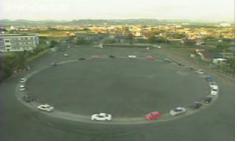
This is fascinating to watch: A team of Japanese researchers have created “shockwave traffic jams” that replicate the dynamics of real-world highways.
For 15 years, researchers have known that traffic jams can emerge out of the blue. All it takes is for one driver to momentarily slow down, at which point the person behind him hits the brakes, forcing the person behind him to hit the brakes even harder, and so on, and so on. One teensy butterfly flaps its wings, and pretty soon the whole damn interstate’s a mess. If you’re in a helicopter, you can watch the “shockwave” of slowed-down cars propagate backwards through traffic like a wave through water. Physicists have long produced eerily accurate computer models that replicate this phenomenon precisely. But because it’s pretty hard to commandeer an entire highway for the purposes of research, no one has ever replicated the phenomenon in a real-world experiment.
Until now! The Japanese team got a cluster of vehicles to drive in a circle. As the New Scientist reports, here’s what happened:
They asked drivers to cruise steadily at 30 kilometres per hour, and at first the traffic moved freely. But small fluctuations soon appeared in distances between cars, breaking down the free flow, until finally a cluster of several vehicles was forced to stop completely for a moment.
That cluster spread backwards through the traffic like a shockwave. Every time a vehicle at the front of the cluster was able to escape at up to 40 km/h, another vehicle joined the back of the jam.
The shockwave jam travelled backwards through the ring of vehicles at roughly 20 km/h, which is the same as the speed of the shockwave jams observed on roads in real life, says lead researcher Yuki Sugiyama, a physicist in the department of complex systems at Nagoya University.
“Although the emerging jam in our experiment is small, its behaviour is not different from large ones on highways,” he told New Scientist.
Check out the video of the experiment. Towards the end, the shockwave becomes deliciously mobile — you can really see it moving backwards.
This also puts me in mind of William Beatty, the electrical engineer who — while stuck in traffic in 1998 — figured out a way to hack traffic jams and erase them. Basically, when he was stuck in a jam, he’d slow down until he had a really large amount of space between him and the car in front of him. Then he moved forward in at very slow, uniform speed, so that he no longer stopped and started. Sure enough, the wave stopped at him: Everyone behind him began driving at a uniform 35 mph. “By driving at the average speed of the traffic around me, my car had been ‘eating’ the traffic waves,” he wrote. The only problem, of course, is that he himself was stuck traveling at the average speed of the wave in front of him, which — at 35 mph — is pretty pokey.
(Thanks to Greg Sewell for this one!)
I'm Clive Thompson, the author of Smarter Than You Think: How Technology is Changing Our Minds for the Better (Penguin Press). You can order the book now at Amazon, Barnes and Noble, Powells, Indiebound, or through your local bookstore! I'm also a contributing writer for the New York Times Magazine and a columnist for Wired magazine. Email is here or ping me via the antiquated form of AOL IM (pomeranian99).

ECHO
Erik Weissengruber
Vespaboy
Terri Senft
Tom Igoe
El Rey Del Art
Morgan Noel
Maura Johnston
Cori Eckert
Heather Gold
Andrew Hearst
Chris Allbritton
Bret Dawson
Michele Tepper
Sharyn November
Gail Jaitin
Barnaby Marshall
Frankly, I'd Rather Not
The Shifted Librarian
Ryan Bigge
Nick Denton
Howard Sherman's Nuggets
Serial Deviant
Ellen McDermott
Jeff Liu
Marc Kelsey
Chris Shieh
Iron Monkey
Diversions
Rob Toole
Donut Rock City
Ross Judson
Idle Words
J-Walk Blog
The Antic Muse
Tribblescape
Little Things
Jeff Heer
Abstract Dynamics
Snark Market
Plastic Bag
Sensory Impact
Incoming Signals
MemeFirst
MemoryCard
Majikthise
Ludonauts
Boing Boing
Slashdot
Atrios
Smart Mobs
Plastic
Ludology.org
The Feature
Gizmodo
game girl
Mindjack
Techdirt Wireless News
Corante Gaming blog
Corante Social Software blog
ECHO
SciTech Daily
Arts and Letters Daily
Textually.org
BlogPulse
Robots.net
Alan Reiter's Wireless Data Weblog
Brad DeLong
Viral Marketing Blog
Gameblogs
Slashdot Games

