
« PREVIOUS ENTRY
What can computers teach that textbooks and paper can’t?
NEXT ENTRY »
Come for the design, stay for the text
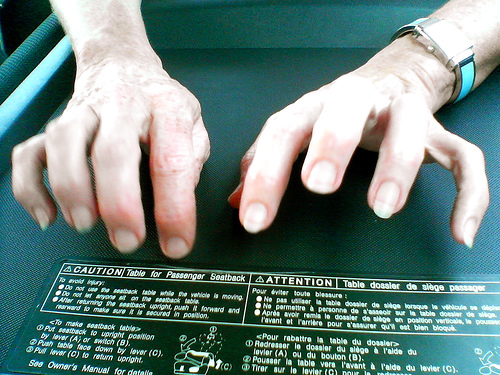
I’m a twitchy guy.
I have a huge amount of nervous energy, which I expunge via nearly-constant motion: I bounce my leg up and down, drum all sorts of polyrhythms on tables and desks, and — when my hair is longer — twiddle it. When I get all three going at once, which occurs with a certain dread periodicity (usually when I’m on deadline), I probably seem like some sort of tweaking meth-head. When I’m in public I tend to keep an eye on this behavior so that I don’t look too weird. I’ll bob my leg up and down — but very, very gently.
Occasionally, though, I’ll be sitting in a cafe, reading the paper, enjoying my ninth or tenth coffee of the morning and gently vibrating … when someone a table over will look over at me with a frown and say: “Do you have to do that?” Mortified, I’ll immediately cease all motion.
This doesn’t happen often. But it happens regularly enough that I’d long begun to suspect there is some fraction of the public who — for some reason — are sensually predisposed to hate the sounds and sights of twitchy people.
It turns out my suspicions were correct! In today’s New York Times science section there’s a great story about “misophonia”:
For people with a condition that some scientists call misophonia, mealtime can be torture. The sounds of other people eating — chewing, chomping, slurping, gurgling — can send them into an instantaneous, blood-boiling rage.Or as Adah Siganoff put it, “rage, panic, fear, terror and anger, all mixed together.”
“The reaction is irrational,” said Ms. Siganoff, 52, of Alpine, Calif. “It is typical fight or flight” — so pronounced that she no longer eats with her husband.
The article focuses on the sounds of people eating, but online resources note that many of the things I do — leg tapping, hair twirling — are also frequent triggers for misophonic rage.
And fascinatingly, it is rage: The folks with misophonia quoted in the Times talk about how they feel their blood boiling when they’re bombarded with a trigger, until they’re compelled to speak out. (“If I don’t say anything, the rage builds,” one notes. And interestingly, for her, the act of speaking out quells her misophonia, at least temporarily.) It also realized that though I don’t think I have misophonia, there are times when I’m so repelled by the noise somebody makes while eating that I, too, want to yell at them.
Nobody’s sure what causes it; some neuroscientists believe it’s hard-wired. And certainly nobody wants it: It makes their lives miserable, sometimes ruining friendships when they can’t tolerate they way someone eats or pronounces the letter “p”.
At any rate, it’s going to make me ever more careful to control my twitchiness in public places, particularly where other people are trying to work or read.
(That photo of tapping fingers courtesy the Creative-Commons-licensed Flickr stream of George Hatcher!)
I'm Clive Thompson, the author of Smarter Than You Think: How Technology is Changing Our Minds for the Better (Penguin Press). You can order the book now at Amazon, Barnes and Noble, Powells, Indiebound, or through your local bookstore! I'm also a contributing writer for the New York Times Magazine and a columnist for Wired magazine. Email is here or ping me via the antiquated form of AOL IM (pomeranian99).
ECHO
Erik Weissengruber
Vespaboy
Terri Senft
Tom Igoe
El Rey Del Art
Morgan Noel
Maura Johnston
Cori Eckert
Heather Gold
Andrew Hearst
Chris Allbritton
Bret Dawson
Michele Tepper
Sharyn November
Gail Jaitin
Barnaby Marshall
Frankly, I'd Rather Not
The Shifted Librarian
Ryan Bigge
Nick Denton
Howard Sherman's Nuggets
Serial Deviant
Ellen McDermott
Jeff Liu
Marc Kelsey
Chris Shieh
Iron Monkey
Diversions
Rob Toole
Donut Rock City
Ross Judson
Idle Words
J-Walk Blog
The Antic Muse
Tribblescape
Little Things
Jeff Heer
Abstract Dynamics
Snark Market
Plastic Bag
Sensory Impact
Incoming Signals
MemeFirst
MemoryCard
Majikthise
Ludonauts
Boing Boing
Slashdot
Atrios
Smart Mobs
Plastic
Ludology.org
The Feature
Gizmodo
game girl
Mindjack
Techdirt Wireless News
Corante Gaming blog
Corante Social Software blog
ECHO
SciTech Daily
Arts and Letters Daily
Textually.org
BlogPulse
Robots.net
Alan Reiter's Wireless Data Weblog
Brad DeLong
Viral Marketing Blog
Gameblogs
Slashdot Games

