

The New York Times’ Arts and Leisure section recently asked me to write a piece about the “serious games” movement — games that are designed to try and influence people and bring about political change. The piece ran on Sunday, and a copy of it is online free at the Times site for a few more days. A permanent copy is archived below!
Saving the World, One Video Game at a Time
by Clive ThompsonLast week, in an effort to solve the Israeli-Palestinian crisis, I withdrew settlements in the Gaza Strip. But then a suicide bomber struck in Jerusalem, the P.L.O. leader called my actions “condescending,” and the Knesset demanded a stern response. Desperate to retain control, I launched a missile strike against Hamas militants.
I was playing Peacemaker, a video game in which players assume the role of either the Israeli prime minister or the Palestinian president. Will you pull down the containment wall? Will you beg the United States to pressure your enemy? You make the calls and live with the results the computer generates. Just as in real life, actions that please one side tend to anger the other, making a resolution fiendishly tricky. You can play it over again and again until you get it right, or until the entire region explodes in violence.
“When they hear about Peacemaker, people sometimes go, ‘What? A computer game about the Middle East?’” admits Asi Burak, the Israeli-born graduate student who developed it with a team at Carnegie Mellon University in Pittsburgh. “But people get very engaged. They really try very hard to get a solution. Even after one hour or two hours, they’d come to me and say, you know, I know more about the conflict than when I’ve read newspapers for 10 years.”

Ever heard of Amazon’s new company, Mechanical Turk? The concept is pretty simple: You sign up as a Turk, and go to the site to see what jobs are available. The jobs all consist of some simple task that can be performed at your computer — such as viewing pictures of shoes and tagging them based on what color they are. You get a few pennies per job, and according to a recent story in Salon, some people make up to $30 a day by clicking away at these nearly-mindless tasks during slow moments at their day job.
What I love about the Mechanical Turk is that it capitalizes on an interesting limitation in artificial intelligence: Computers suck at many tasks that are super-easy for humans. Any idiot can look at picture and instantly recognize that it’s a picture of a pink shoe. Any idiot can listen to a .wav file and realize it’s the sound of a dog baring. But computer scientists have spent billions trying to train software to do this, and they’ve utterly failed.
So if you’re company with a big database of pictures that need classifying, why spent tens of thousands on image-recognition software that sucks? Why not just spend a couple grand — if that — getting bored cubicle-dwellers and Bangalore teenagers to do the work for you, at 3 cents a picture? As Amazon notes in its FAQ:
For software developers, the Amazon Mechanical Turk web service solves the problem of building applications that until now have not worked well because they lack human intelligence. Humans are much more effective than computers at solving some types of problems, like finding specific objects in pictures, evaluating beauty, or translating text. The Amazon Mechanical Turk web service gives developers a programmable interface to a network of humans to solve these kinds of problems and incorporate this human intelligence into their applications.
Mind you, while the cognitive-science aspects of the Mechanical Turk are incredibly cool, the labor dimensions freak the hell out of high-tech labor unions. “What Amazon is trying to do is create the virtual day laborer hiring hall on the global scale to bid down wage rates to the advantage of the employer,” as one WashTech organizer argues. Either way, it’s a really odd way to think of human intelligence: Just more processing time, a few more cycles in the machine, and the global community of freelance workers a massively-parallel computer, floating out there in the aether like the world’s hugest graphics card.
I actually wrote a little essay for Wired in 2002 that predicted this, sort of.
(Thanks to Jason Fisher for this one!)

Apparently Eric Church, a rising star in country music, has tons of text messages on his phone. But according to this profile in the New York Times, the messages aren’t actual communications from other people …
… Many of those text messages filling up his cellphone aren’t from old friends or new fans or enthusiastic label executives. They’re from Mr. Church himself. He’ll be in a tour bus for the foreseeable future (“My true next weekend off is in December,” he said), which means he doesn’t get much time to write songs. So whenever he thinks up something that might work, he punches it into his phone and hits send. “It’s over a hundred of ‘em,” he said, sheepishly. “Often just a line, or a title. I don’t get a chance to finish stuff.”
I love it! Life hacks born from the everyday necessities of travelling country musicians.

This posting will self-destruct in 36 hours.
Well, it won’t actually vanish. But most of its audience will be gone by then — because, according to a new study, the lifespan of a news item on a website follows a power-law curve: The readership for a story is biggest in the first day and a half, decays rapidly, then flattens out into a long tail. That’s what Albert-László Barabási, the famous network-theory scientist, discovered when he observed the browsing behavior of 250,000 visitors to a Hungarian news site. As PhysicsWeb reports:
Barabasi’s team calculated the “half-life” of a news document, which corresponds to the period in which half of all visitors that eventually access it have visited. The researchers found that the overall half-life distribution follows a power law, which indicates that most news items have a very short lifetime, although a few continue to be accessed well beyond this period. The average half-life of a news item is just 36 hours, or one and a half days after it is released.
I can definitely attest that this is true, by looking at my own blog’s log files. Whenever I get tied up in work and can’t blog — as in the last two weeks — my readership drops quickly until it reaches a long-tail equilibrium, and stays there. Then when I start posting again it zips back upwards. So long as I post regularly, there’s always a large audience, because the rolling 36-hour periods for each posting overlap.
That funky graphic above has something to do with the study — I’m not 100% just what, but it looked pretty cool so I included it.
(Thanks to Morgan for this one!)

I’m coming a week late to this — another crazed-workweek drought of blogging around here, I’m afraid — but Wired News published my latest video-game column. This one is about an interesting academic study showing that in some situations, gamers enjoy sucking at a game as much as excelling. The piece is online here, and a copy is permanentl archived below:
The Joy of Sucking
by Clive ThompsonI suck at Super Monkey Ball bowling. It’s a simple game: You aim a little ball with a tiny monkey down a surrealist bowling lane, which floats in outer space. Aim with precision and the monkey sends the pins flying. Put too much English on the ball and it goes sailing off the edge of the lane, the monkey shrieking as it plummets through the void.
Last week I tried the game for the first time, and quickly discovered that I had zero kung fu. Time after time, I sent the poor monkey wailing off into outer space. Like I said: I suck.
But here’s the thing: According to a new scientific study (.doc), I was nonetheless having a really good time. Failing at a game, the study argues, can be just as pleasant as succeeding.
I’m writing a piece about this fall’s impending Madden NFL 07 game. I’m interested in interviewing a few long-time Madden fans to find out what they think of how the series has evolved!
Anyone out there a) a big Madden fan, and b) want to talk about their thoughts on how the game has changed over time?
If so, email me here and let me know how to contact you!

This is lovely: A Polish artist reskinned Space Invaders so the aliens look they were designed by ancient Armenian carpet weavers. Then he projected the game onto … an actual, ancient Armenian carpet! The result is a gorgeous, playable rug that riffs neatly off the uncanny aspects both of video games and the mythology of magic carpets. From a web-site writeup:
Janek Simon unites the old geometric designs of Caucasian and Armenian carpets with the low-resolution abstractness of the Space Invaders. The collector carpet furnishing the ethnic-design, world-cuisine magazine becomes a new shopping item for the homecoming marines and the kid back home. It is the Oriental rug for your portable arcade mosque. Follow the voice of the Joystick prophet.
Check out closeups here. Okay, I want a full set of these for my apartment, one for each classic game. Imagine the Pac-Man maze as your carpeting, rendered playable with the flick of a switch!
(Thanks to Kotaku for this one!)

Behold Bossaball: A version of volleyball that takes place on an enormous bouncy inflatable cushion — and includes two trampolines that propel players a dozen feet in the air, giving them insane hangtime and allowing them to deliver spikes with Scud-missile velocity. You’re also allowed to use your feet. Oh, and there’s a DJ whose job it is to synch music up with the plays.
See those three pictures above? They’re stills from a bossball clip, in which the player holds the ball between his feet, does a backflip six feet in the air, and uses his legs to hurl the ball across the net. Heh. Check out other clips here; as the official website describes the game …
It’s a mix between volleyball, football, gymnastics and capoeira.
To say the least. Obviously, bossball is apiece with other nouveau sports created in recent years — such as the Slamball that Spike TV has been broadcasting, which also uses trampolines. In one sense, they’re pretty silly stuff; part of their appeal is not so much that they’re good sports, but that it’s fun watching people boinging around in the air.
But it reminds me of a question that often occurs to me: Why are there so few new sports created?
All the main ones — soccer, football, baseball, basketball — were codified and mass-marketified decades ago. Why not engineer some new ones? It’s hardly likely that we’ve exhausted all forms of play possible in the physical world, right? In the video-game world, designers have been on a tear for 20 years, pioneering new rulesets that create brilliant, fiendishly tricky play systems. Why haven’t we been equally as inventive in the “real” world?
Bossaball and slamball may be rather marginal, but they’ve at least attempted to engineer a new play mechanic: The use of springboards to expand the vertical range of the athletes. Granted, the springboards are precisely why the games seem so goofy. But at least the designers are trying! And one could imagine that in our age of high-tech materials, a smart game designer could craft gameplay that offered new human abilities without being quite so daffy.
I think part of the problem is that we’ve forgotten that our major sports were, at some point in the past, designed. Baseball and football and soccer and basketball haven’t been with us since the beginning of time. They used to, y’know, not exist, and they only exist now because some dogged game designers had an interesting idea and kept tweaking and tweaking the rules until what emerged was the sports we now know and love. In that sense, baseball’s like an iPod: It’s the product of a bunch of gorgeously organic design decisions that make the whole thing just feel right. (Imagine if there were five bases: That one design change would create quite a different — and probably much worse — game, eh?)
I think there’s something about our physical sports that makes their design process seem invisible. They don’t seem like designed objects; they just are. That makes designers unlikely to want to create new sports, and more importantly, audiences unlikely to want to learn and appreciate a new one. It’s probably significant that video games — which have ushered in a renaissance of new forms of play — inititally appealed to geeks who generally weren’t interested in physical sports. They were the only people who craved new forms of play.
(Thanks to Jenny Springsteen for this one!)
How are MySpace, Google, blogs and Amazon’s recommendation algorithms changing journalism?
I recently tackled that question in an essay I was invited to write for Canadian Broadcasting Corporation. Their web site — cbc.ca — just celebrated its 10th anniversary, so they asked several writers and pundits to muse on how journalism is morphing in the age of the Internet. My essay is online for free here, and there’s a copy archived below. (Regular readers of this blog will notice that the essay relies heavily on various lines of thinking I’ve pursued in previous blog postings!)
Also check out Cory Doctorow’s contribution, which does a superb job of tackling the question of veracity, authority, and truth online in the wake of the Wikipedia brouhaha.
Media in the age of the swarm
by Clive ThompsonHere’s the bad news: The bestseller is dying.
Here’s the good news: The bestseller is dying.
Let me unpack that a bit. Recently, a study found that the amount of time the average bestseller spends on the charts has been eroding steadily, for decades. Back in the 1960s, only three books on average each year hit the #1 spot on the New York Times bestseller list — and they stayed there for 21 weeks. In the last five years, things have been much more democratic; over 18 books a year become #1 bestsellers. But they remain there for only three weeks. No single book, it seems, can command the sort of broad and longstanding civic attention that “big” ideas used to regularly enjoy. This is the sort of finding that tends to terrify journalists: If the nation can’t focus on one single issue at time, how can writers make an impact?
But it turns out things aren’t quite so dire — once you understand what’s really going on. It isn’t merely that the bestseller is struggling. It’s that the nature of popularity itself is changing — the nature of society’s attention span, as it were. And this has deep implications for the future of all types of journalism.

Behold an ancient Japanese “Sangaku” table — the Sudoku of the 17th century.
Sangaku emerged during the 100-year period that Japan forcibly cut itself off from West, allowing only one Dutch ship a year to dock. The cultural isolation did some weird things to the country’s mathematicians. Because they never heard about calculus — which was developed in Europe — they developed brute-force ways of solving classic calculus problems, such as how many circles of a particular size fit in a square. They’d draw the enormous, sprawling solutions out on beautifully illustrated wooden tables, which they regarded as religious offerings. (I love it: Using math to praise God. Man, wouldn’t it be nice if more religious conservatives in the US made that connection? It’s quite a venerable once, too, since many historic mathematicians — most particularly Newton — regarded math as the language in which God spoke.)
Anyway, Sangaku fell into disrepute during the 20th century, but Tony Rothman, a Princeton Nobel nominee, is helping spearhead a movement to restore what he calls the sudoku of the 17th century. Like Sudoku, Sangaku was based in principles so simple that children could solve them, as Rothman says in this story:
“Some of the tablets feature solutions provided by 12-year-olds,” he said. “But that doesn’t mean they were easy. Today’s high school geometry problems tend to require only five or six lines to solve, whereas the old problems often demand pages and pages of work. Sangaku were more like math Olympics problems, or the sort of thing your teacher might have put on the wall for extra credit.”

According to a new study, having even one stiff drink can make you literally “blind drunk” — unable to see something right in front of you.
Seema Clifasefi, a psychologist at the University of Washington, did the experiment thusly: She took a bunch of subjects and gave ‘em a highball. In some cases, the drink was actually alcoholic; in other cases it tasted like the real thing but was dealcoholized, and the subjects didn’t know which they’d gotten. Then they had to watch a 25-second clip of three people playing basketball and were asked to count the ball passes. Part way through the clip, a guy in a gorilla suit walked across the court, beat his chest, and walked off.
Here’s the thing: The people who had the alcoholic drink were twice as likely as the others to not notice the gorilla — even though it walked literally between the basketball players.
The upshot? Bad news for people who think they can have one drink and still drive competently — since obviously they won’t be able to pay attention to multiple stimuli. As Clifasefi said in a press release:
“We rely on our ability to perceive a multitude of information when we drive (speed limit, road signs, other cars, etc.) If even a mild dose of alcohol compromises our ability to take in some of this information, in other words, limits our attention span, then it seems likely that our driving ability may also be compromised … If you’ve had one drink, you may be so focused on paying attention to your speed so as not to get pulled over, that you completely miss seeing the pedestrian that walks directly in front of your car.”
In psychological lingo, this is a test that proves “inattentional blindness” — the point at which our attention becomes so overloaded that we fail to notice things under our noses. The gorilla-suit test was invented a few years ago and has become a classic: It even works on totally sober people, since many of them, too, become so absorbed in the basketball game they fail to notice the dude in an ape suit. But nobody had ever tested whether alcohol exacerbates inattentional blindness. Now we know!
And of course, alcohol isn’t the only thing degrading drivers’ attention-spans. A flurry of recent research has shown that everything from sexy pictures to mobile phones can so impair people’s driving and perceptual abilities as to render them effectively legally blind and legally drunk. With all the Motorola Razrs glued to people’s cheeks as they cruise past enormous roadside Hooters billboards, it’s amazing the highways aren’t a towering pile of twisted, burning metal.

Behold the Suzuki LC — a concept car the company released this year. It’s an update of the 1955 Suzulight, Suzuki’s first-ever automobile that launched the firm. As Automobile Magazine describes it:
The LC microcar has space for only two people inside its two-door, 10.5-foot-long body. The split-level cabin with plaid seats is decidedly minimalist, but the detailing throughout the car is fantastic. Suzuki’s three-cylinder, 660-cc minicar engine is under the hood. It’s just the car for zipping through Tokyo’s crowded streets.
I want one this instant. I had long planned to buy a Nash Metropolitan, a squat little 1950s car that looks precisely like this one, so I could do a cross-country road trip in it. But then I discovered that, alas, most Metropolitans have a top speed of about 50 mph, which would rule out much interstate driving. I bet an LC could break 60 or 70 mph, though!
(Thanks to El Rey for this one!)

I blogged earlier today about my Wired News column about why there isn’t yet a Lester Bangs — a well-known, genre-defining critic — for video games. You can read the column here and here, but one of the points I made was that video games have been the first new form of entertainment to grow up in age of blogging — where amateur writers outstrip the pros. Sure, there’s no Lester Bangs for video games in Rolling Stone, nor a comparable Pauline Kael in the New Yorker. But there are thousands of smart, thoughtful bloggers and forum members that every day post better writing than the stuff you’ll read in the mainstream press.
In particular, I namechecked 1UP, the excellent video-game community site. Today I went to the 1UP forums, pumped in “Lester Bangs” to see what people were saying, and found that a guy named Mark Freid had posted this exchange from a 1982 with Lester Bangs himself:
Interviewer: Do you think there’s a danger of rock ‘n’ roll becoming extinct?
Bangs: Yeah, sure. Definitely.
Interviewer: What would there be to take its place?
Bangs: Video games. A lot of things we don’t like to think about.
It’s both prophetic and inadvertantly meta. Perfect.
By the way, if you go to the discussion thread where that quote came from, read through the entire thing. You’ll see what I mean about why the online world is eating the pros for lunch in video-game criticism. The posters are smart, erudite, casual, passionate — everything you’d want in video-game writing.

Remember how you’d play Tetris for five hours solid and then, when you lay down in bed at night, couldn’t stop seeing the blocks falling in your mind? Make that sensory hallucination a reality with this excellent Tetris shelving — wall units that are shaped like the infamous bricks! You actually buy each “brick” individually and assemble them in whatever configuration you want. As the designers, Brave Space, describe them:
This pack flat version of our Tetris Shelving ships to your door and assembles in minutes. With wooden sides and a metal backing, the Tetris Flat is a modular lightweight unit. Blocks can be attached to one another, to the wall or left free floating for life-sized, living room game play. And no, the bottom line doesn’t disappear when you make that perfect configuration.
I am so getting these for my kid’s bedroom.
(Thanks to Sensory Impact for this one!)

Wired News just published my latest video-game column — and this one is a response to Chuck Klosterman, the cultural critic who recently asked an intriguing question: Why aren’t there any nationally-famous video-game writers? It’s online free at Wired News, and an archival copy is also below:
Why No Lester Bangs of Gaming?
by Clive ThompsonWhy aren’t there any famous critics of video games?
Chuck Klosterman wants to know. In a recent column for guymag Esquire, he argues that games are the most important cultural medium of our times — “the culture equivalent of rock music in 1967” — yet they haven’t produced a generation of acerbic, barnstorming writers the way rock and film did. “There is no Pauline Kael of video-game writing. There is no Lester Bangs of video-game writing,” Klosterman says. What’s going on?
It’s a hell of a good question, and it deserves an answer. Unfortunately, Klosterman so elegantly misunderstands gaming culture — and the nature of games themselves — that he misses out on all the real reasons. So let me go all godmode here and answer the question for him.


Pull out a vinyl record from the 70s or early 80s, and listen to it. Odds are it’ll have a big dynamic range — it’ll be whisper-quiet in some parts and booming loud in others. You’ll pick up new nuances every time you listen to it. Now listen to any music track recorded in the last ten years, and it’ll be radically different. That dynamic range is gone: The entire track is loud, all the way through. The sound sounds a lot more intense, and it “grabs” you more quickly the first time you hear it. But does it still reward re-listening?
Nope, says a writer at Stylus magazine. In this amazing and lengthy piece, he argues that the “loudness wars” are destroying music. Record labels for decades have tried to make records louder, on the mostly-correct theory that louder music is more likely to pull you in on first listen. But the way you make music louder is via “compression”. In a normal recording of music, the loudest parts — the peaks — are much higher than the quietest ones, the valleys. Compression shrinks the difference between the peaks and valleys, so there’s less dynamic range; this frees up more room up top so you can boost the whole volume of the entire song.
See those two graphs overhead? The original is Abba’s “One of Us” as recorded in 1981, and you can see the wide dynamic range. The second graph is “One of Us” remastered in 2005, compressed to make all of the sound-wave “big” and louder. The author also argues that the jump-the-shark moment for the recording industry was … Oasis. In 1987, the average album like Appetite for Destruction by Guns ‘N Roses had a dynamic range of 15 decibels. Oasis’ 1994 (What’s the Story) Morning Glory had a range of a mere 8 decibels — compressed to make it louder and louder.
But so what? Why does this hurt music? Because of the psychoacoustics of how loudness and quietness affects us. When a song has less dynamic range, even if it’s louder we are — paradoxically — more likely to tune it out, as the author argues. It’s worth reading his entire essay, but here are some excerpts:
I’ve messed around with lots of home-recording technology — for music and for my Wired podcasts — and this guy’s right. Compression is addictive. I use a Joe Meek MQ3 to compress recorded instruments and voices, then T-Racks’ software compressor to further pump up tracks inside Pro Tools, and with each rev the sound gets fatter and more intense. But maybe I’m removing all dynamic appeal from what I’m recording?
(Thanks to Andrew Hearst for this one!)

Finally — someone has released the first mass-market hydrogen-powered car!
Except it’s a toy. Except that’s still pretty cool. As various sites have pointed out, the H-Racer makes for a great educational toy, since it shows kids how you can use solar energy to generate hydrogen — which then powers your car to peel rubber through the neighborhood.
Gizomodo made the obvious-but-true joke …
Now all they have to do is just bring this baby up to full size and add a steering wheel. Yeah, that oughta happen in about 200 years or so.
They’re right, for all sorts of sad engineering and political reasons. But here’s the thing: The H-Racer illustrates that fuel-cell technology really is ready for prime time. It’s just that what it’s ready for is not full-sized cars — but pocket-sized gadgets.
The problems standing in the way of fuel cells for full-sized cars are legion: There’s no national infrastructure for delivering hydrogen (like there is for gasoline); getting regulatory approval for a new form of car fuel-system isn’t easy; and in any case the major oil and auto companies have little interest in pursuing alternative fuels right now. But none of this is true of smaller gadgets.
Consider laptops. One energy expert I spoke to a while back argued that it’d be easy to engineer a laptop that would run for 30 hours on a single AA-battery-sized fuel cell. You’d just slide the cell into your laptop, let it do its magic, and replace it when it’s spent. “Sure,” the expert said, “your laptop would generate a tiny bit of water, but that’s not hard to contain and dispose of.” What’s more, battery-sized hydrogen cells could easily be rolled out nationally and sold at corner stores; no distro problem there.
Most business travellers I know would happily endure a laptop that urinated, so long as it lasted all the way to Japan and back on one battery.
(Thanks to Core 77 for this one!)

This is a pretty cool piece of research, which began when a group of Stanford scientists decided to investigate whether financial rewards help motivate people to remember things. So they took a bunch of subjects and offered them various rewards — from “nothing” to $5 — for memorizing pictures. When given a surprise quiz three weeks later, the subjects were much better able to recall the pictures they’d been paid to recall. In fact, the more money you pay them, the better they’d recall stuff.
No surprise there, in a way. Spouses have complained for years that their career-addled partners can recall minor details of contract negotiations at work, but can’t remember their kids’ birthdays. It would seem pretty obvious that our brains are at full attention when our living is on the line.
But here’s an even cooler thing: The scientists did some brain scanning that shows they can predict when someone is going to remember something — even before the subject herself knows she will.
They stuck their subjects’ heads in fMRI tubes to scan for brain-function activity, and noticed that whenever a subject was being offered a larger sum of money (like $5, instead of 10 cents), there’d be increased activity in their ventral tegmental area (VTA — pictured above) and their nucleus accumbens (NAcc). Those areas are both thought to be associated with anticipating rewards. And indeed, whenever activity there was high while viewing a picture, the subjects recalled those pictures better later on than others. So the scientists now theorize that by observing VTA and NAcc activity, one ought to be able to predict whether someone will recall something they’re seeing or hearing.
The Stanford researchers published a Neuron paper on this in May (PDF online here), and as they say in their press release:
“Many prior imaging studies have examined motivation or memory,” Gabrieli said. “But this shows how motivation can set up the brain to learn.”

Yikes: An Ohio study has found that in the last ten years, the state’s animal shelters have been steadily saving more dogs — but killing more cats. Since 1996, the number of dogs they received has decreased by 16 percent, while the number of cats rose by 20 percent. What’s more, the number of dogs euthanized decreased by 39 percent, while the number of cats that were put to sleep increased by nearly 14 percent.
As Lord notes in a press release for the study:
“What’s going on in Ohio is probably pretty reflective of many parts of the country,” she said.
So America is turning into a country of dogs. I like both cats and dogs equally, but I have to say, this news doesn’t necessarily speak terribly well of the country. More and people are demanding unquestioning obedience, uncritical love, and total loyalty: Not exactly a profile of a confident, tolerant, intelligent population, eh?
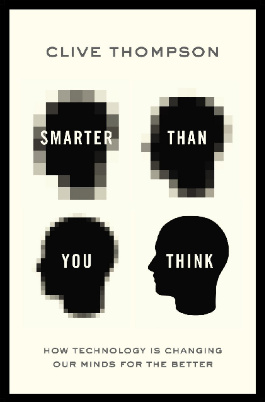
I'm Clive Thompson, the author of Smarter Than You Think: How Technology is Changing Our Minds for the Better (Penguin Press). You can order the book now at Amazon, Barnes and Noble, Powells, Indiebound, or through your local bookstore! I'm also a contributing writer for the New York Times Magazine and a columnist for Wired magazine. Email is here or ping me via the antiquated form of AOL IM (pomeranian99).
ECHO
Erik Weissengruber
Vespaboy
Terri Senft
Tom Igoe
El Rey Del Art
Morgan Noel
Maura Johnston
Cori Eckert
Heather Gold
Andrew Hearst
Chris Allbritton
Bret Dawson
Michele Tepper
Sharyn November
Gail Jaitin
Barnaby Marshall
Frankly, I'd Rather Not
The Shifted Librarian
Ryan Bigge
Nick Denton
Howard Sherman's Nuggets
Serial Deviant
Ellen McDermott
Jeff Liu
Marc Kelsey
Chris Shieh
Iron Monkey
Diversions
Rob Toole
Donut Rock City
Ross Judson
Idle Words
J-Walk Blog
The Antic Muse
Tribblescape
Little Things
Jeff Heer
Abstract Dynamics
Snark Market
Plastic Bag
Sensory Impact
Incoming Signals
MemeFirst
MemoryCard
Majikthise
Ludonauts
Boing Boing
Slashdot
Atrios
Smart Mobs
Plastic
Ludology.org
The Feature
Gizmodo
game girl
Mindjack
Techdirt Wireless News
Corante Gaming blog
Corante Social Software blog
ECHO
SciTech Daily
Arts and Letters Daily
Textually.org
BlogPulse
Robots.net
Alan Reiter's Wireless Data Weblog
Brad DeLong
Viral Marketing Blog
Gameblogs
Slashdot Games

