FREE counter and Web statistics from sitetracker.com
August 28, 2007
Unmarried couples share housework more equally than married ones


Here's an interesting finding: It turns out that unmarried couples who live together are more likely to share the housework equally than married couples. That is, men in unmarried couples do more housework than married men, and women in unmarried couples do less housework than married women. Why? Possibly because, as the authors -- Theodore Greenstein and Jennifer Gerteisen Marks of North Carolina State University -- suggest, marriage is such a culturally powerful institution that men and women shift their views of themselves when they say "I do".

As extra proof, Gerteisen points out that this shift occurs even in couples that have an "egalitarian" point of view -- i.e. where they believe that men and women ought to share the work equally. When couples like this marry, the men still wind up doing less of the work. As Gerteisen says in a press release:

"Marriage as an institution seems to have a traditionalizing effect on couples -- even couples who see men and women as equal," says Davis.

You can read their full study online here as a PDF if you want. There's a lot of fascinating data here, and it seems reasonably solid; the researchers polled 17,636 respondents in 28 nations. (Mind you, there are the usual problems with this sort of research -- i.e. partners might be misreporting the amount of housework they do, either adjusting it up or down.)

Here's one interesting finding buried towards the end: It turns out that in households where the women make a lot more the men, the men report doing more housework -- but the women do not report their housework going down. Someone's perceptions are off: Either the men or women are overestimating the housework they do in this situation. What's going on? The authors suggest this curious result might be because of men and women have divergent attitudes towards the meaning of work and money.

Men, they hypothesize, "are more likely to see money as a way to 'buy out' of housework." So in situations where the women makes a lot more money than they do, they see their partner as having "bought out" of housework; consequently, they themselves ought to be picking up the slack. In this situation, they're more likely to feel okay about reporting that they do more housework, whether or not they're actually doing it.

But the women, the scientists suggest, have a different view. They're "more likely to view money as power within the relationship that is not as directly tied to hours of housework": i.e. making more money, for them, means they're storing up credit to be dispended in other parts of their relationship negotiations. They don't see themselves as "buying their way out of work" -- so they report doing the same amount of housework (again, whether or not their amount has actually gone down.)

At least, I think I'm reading the study correctly. Someone check it out and let me know if my interpretation of this is off. It's really intriguing, either way.

Posted by Clive Thompson at 12:47 PM
Why scary games are better than horror movies: My latest Wired gaming column


Today, Wired News published my latest video-game column -- in which I argue that scary games are now doing a better job than scary movies in carrying on the traditions of horror. The piece is online for free here, and a copy is below!

Gore Is Less: Videogames Make Better Horror Than Hollywood
by Clive Thompson

I'd only been playing BioShock for 15 minutes, and already I was trembling like a little girl.

It's hard to disentangle what precisely was scaring the crap out of me. Maybe it was hearing the rumbling moans of a nearby Big Daddy, and realizing it was hunting for me. Maybe it was the way those filthy, genetically modified humans would pop out of nowhere, dressed, improbably, in Victorian clothes and creepy Eyes Wide Shut clown masks. Or maybe it was their weirdly garbled dialogue -- how they'd shriek, "Get away from me!" while slashing at me with lead pipes.

The fact is, I like to be scared out of my wits. I'm one of those wimps who is easily spooked yet generally enjoys the sensation. So ever since I was a kid, I've loved good horror movies -- I'd turn out the lights freak myself out with classics like Halloween, Friday the 13th or The Exorcist.

Yet here's the thing: For several years now, I've found that my favorite horror experiences aren't coming from movies any more. They're coming from games.

Why? Partly it's because films have become much less artistically interesting. With a choice few exceptions -- like the superb The Ring -- I've found that modern horror movies have been offering less and less suspense, and more and more gore. Maybe it's due to the rampaging success of Saw, which gave birth to the current trend toward torture-chic and metric tonnage of blood in scary movies.

In contrast, the best scary-game designers have quietly perfected the interplay of tension and release that makes for a truly cardiac horror experience. They have, in a sense, become even more faithful interpreters of the horror tradition movies than Hollywood directors.

In BioShock, for example, the audio editors are masterful at generating free-floating anxiety. As you wander through the game's ruined city, whispering voices pan in and out of your skull. Often it's the semilucid/semicrazy patter of the gibbering "splicer" humans, but either way, it makes you feel as nuts as they are.

Even worse is the sound of the ultra-Freudian evil-girl Little Sisters. Every time I'd stumble into a dark room and hear one of them say "What's that sound, Mr. Bubbles?" in her chirpy, gargling-on-blood voice, the hair on my neck stood up. It was partly because, well, evil little girls are scary, and partly because I knew I was about to get my ass handed to me.

Indeed, the endless potential for ass-handing is why games may actually be a superior medium to films for scaring the bejesus out of you. The horror flicks of the '80s always tried to generate a sort of proto-interactivity: all those terrified viewers, screaming "Don't go in there!" at the screen, wishing they could somehow reach out and personally guide the Final Girl to safety.

In a game, of course, the fourth wall is obliterated, and you actually do have the choice about whether to go into The Bad Room or to run screaming. If you're a total coward (like me) this ability to control your fate induces considerably more suspense, because I head-game myself into a frenzy. I'll start down a corridor, hear something freaky up ahead, then freeze in panic. Maybe if I stay quiet the monster will go away? Shit, maybe it's already headed this way, and I should move! But if I move the monster will hear me ... so maybe I should stay quiet ... gaaaaah!

Games already seem like dream states. You're wandering around a strange new world, where you simultaneously are and aren't yourself. This is already an inherently uncanny experience. That's why a well-made horror game feels so claustrophobically like being locked inside a really bad -- by which I mean a really good -- nightmare.

Still, there are some interesting limitations on the form. I find that scary games almost always lose their scariness after about three hours. This is due to the inherent repetitiveness of games: After you've fought your 200th "splicer" in BioShock, you're pretty accustomed to their gurgly ramblings, their patterns of attack, the boo-yah outta-nowhere teleportations. I was still tense, but no longer, you know, wetting myself.

The only way a game can continue to frighten you is if it constantly subjects you to new scary things, keeping you eternally off balance. But few publishers are willing to spend money on enough designer hours to churn out 40 hours of genuinely new content. Instead, they inevitably wind up recycling the same opponents, the same animations, and perhaps worst of all, the same audio cues. (The quickest way to ruin a scary mood is to have the monsters endlessly repeat the same two or three catchphrases over and over again; it begins to feel like telemarketing.) The best horror games -- I'd include some of the Silent Hill and Resident Evil titles in this category -- have come the closest to keeping things fresh as you play.

Still, I'm not complaining too much. BioShock was plenty freaky enough; I wrote this column with the lights on.

Posted by Clive Thompson at 12:23 PM
August 27, 2007
If you can read this, you're probably already drunk


This is a lovely bit of design: An ad for Guiness that consists of warped text on a beer coaster, which only becomes legible when the drink is poured. (Sorry for the overly-massive image, but you can only see the effect when the picture is big enough.)


(Thanks to Andrew Hearst for this one!)

Posted by Clive Thompson at 03:01 PM
Study: Fake apologies are as good as sincere ones


When someone gives you an insincere apology -- i.e. it's pretty clear they're not actually sorry, but they're being forced by someone else to say so -- how do you react?

Psychologists have long observed that, counterintuitively, people accept forced apologies as graciously as they accept genuine ones. Grade-school teachers frequently remark on this: They watch as a colleague drags a surly 5th grader over to deliver a clearly fake and insincere apology to another 5th grader -- upon which the aggrieved party happily accepts the apology and skips away.

What's going on? Those of us who witness such incidents are incredulous: We know that the apologies are fake. So why do the aggrieved parties accept them so readily?

Jane Risen and Thomas Gilovich, two psychologists at Cornell, recently staged five different experiments in which people insulted a study subject, and then were forced to apologize -- either voluntarily and sincerely, or upon being forced to, i.e. insincerely. They found that, as they'd suspected, all the insulted parties were generally equally content with both the sincere and coerced apologies. They didn't judge their insulter harshly. But other participants in the experiments who witnessed the incidents were unconvinced by the insincere apologies -- and they did judge the insulter harshly.

The reason for this disparity, the scientists argue, is that people who are receiving the apology and those who are watching the exchange are in different social roles:

The target [of an insult] may be motivated to come across as a forgiving person and to restore the smoothness of the social interaction so that the audience does not look down on him or her ... The situation for observers is different. If an observer excuses someone who offers an insincere apology, the observer may be seen as insufficiently empathetic to the victim. It may thus be in the interest of observers to respond differently to sincere and insincere apologies and thereby signal that they care about others.

In one sense, this is perfectly obvious stuff. But it intrigues me because the status of apologies is pretty charged in a number of realms right now. One is politics, where political figures are increasingly regarded as "weak" if they apologize for anything, or even admit they've ever done anything wrong. Another is health care, where studies have shown that doctors who apologize for bad outcomes are considerably less likely to get sued -- but of course, apologizing for even the tiniest thing horrifies their attorneys, who worry that it'd be used for a malpractice suit.

The paper is online here in PDF form if you want to read it yourself.

(Thanks to Top 10 Sources for this one!)

Posted by Clive Thompson at 02:33 PM
"Community urinalysis": Drug-testing an entire city via its sewage


This is both wonderfully practical and totally hilarious: A couple of Oregon scientists developed a technique that lets you take a teaspoon of water from a city's sewer plant and detect which drugs the population is currently using. It's based on a simple point: Every drug you take eventually comes out in your urine, and a community's urine all goes in one direction -- down the toilet.

They've only tested a few different cities, but the regional differences are intriguing:

One of the early results of the new study showed big differences in methamphetamine use city to city. One urban area with a gambling industry had meth levels more than five times higher than other cities. Yet methamphetamine levels were virtually non-existent in some smaller Midwestern locales, said Jennifer Field, the lead researcher and a professor of environmental toxicology at Oregon State.

The ingredient Americans consume and excrete the most was caffeine, Field said. [snip]

She said that one fairly affluent community scored low for illicit drugs except for cocaine. Cocaine and ecstasy tended to peak on weekends and drop on weekdays, she said, while methamphetamine and prescription drugs were steady throughout the week.

This is, of course, largely being viewed as a technique for urban-health analysis and crime prevention: By knowing which drugs are on the rise in a particular city, doctors and police can help prepare for the health implications, and try to combat them. But just imagine the more sordid uses of the information! Like the bragging rights these tests could give to urban decadents, or even travel guides. "New York City -- highest per-capital use of injectable heroin in the nation!!"


(Thanks to Top 10 Sources for this one!)

Posted by Clive Thompson at 02:02 PM
Study finds morning people are "logical", night owls are "creative"


I'm really not a morning person. But according to a new study, this tells you a lot about my personality: I'm more likely to be "creative", "risk-taking", "non-conformist" and "independent" than early risers.

This work came from the psychologist Juan Francisco Diaz-Morales, who recently decided to see if there were any regularities in the personality traits of early risers versus evening people. He took 360 undergraduates, ranked their relative sleep/wake habits, and then scaled them on the Millon Index of Personality Styles. According to the blog of the British Psychological Society, here's what he found:

[Morning people] tend to be of a certain personality: they favour the tangible and concrete, they trust their experience and the observable over intuition and feelings; they have an attention to detail and a preference for logic. They are respectful of authority, care about social conventions and are rarely politically radical. [snip]

In contrast to morning types, evening people preferred the symbolic over the concrete, were creative and risk-taking, and tended to be non-conformist and independent.

Assuming this finding holds water, it'd have some pretty interesting implications for the workplace, eh? A smart company would organize its workday to optimize tasks based on which type of person is needed for the job -- a logic-crunching task versus a blue-skying brainstorm -- and when they're likely to be at their best.

Indeed, I've long suspected that the 9 to 5 schedule is kind of suboptimal for productivity; it's patently clear that different people shine at different times in the day. And you could argue that -- for white-collar work, at least -- the time-delimited bounds of the workday are more up for grabs now than they've ever been. Historically, one big reason we settled on the 9 to 5 timeslot is for purposes of industrial efficiency: We needed people to be at their desks for roughly the same time period so they could work together. But email, mobile phones, and digital documents obviate a lot of those old-skool practical considerations. A lot of the rationale for 9 to 5 worktimes is now practically a phantom-limb phenomenon in corporate culture.

(Alas, the full study is behind a paywall, so I couldn't read it, but here's the official link.)

Posted by Clive Thompson at 01:33 PM
August 26, 2007
Should online newspapers be programmed to "forget" old, incorrect articles?


Here's a fascinating dispatch from the new world of reputation management. The New York Times is now apparently receiving one request a day from people who want the paper to remove an old article from their online archive -- because the article contains incorrect or incomplete information that makes the person look bad, and it's cropping up on Google.

It's an incredibly fascinating and troubling issue. The Times, like most newspapers, often runs a news brief when someone gets in trouble -- but doesn't print a followup when they're cleared of their allegations, because it seems less newsworthy. In the past, this caused the subjects a lot of heartache, of course. But it's far worse now, because a prospective employer, business partner or spouse Googles the person and ... whoops, there's the original news item, in the #1 or #2 slot on Google, still uncorrected, decades later.

What's the answer here? Clark Hoyt, the Times' public editor (pictured above) tackled this one in his weekly column today, and discovered that the news editors at the paper are baffled about what to do. They could acquiesce and remove the articles, but they'd worry about where to draw the line; they don't have enough resources to re-investigate every two-decade-old article that subjects complain about. (Someone could, of course, complain about a perfectly legitimate article in hopes of having it taken down.) And if they start changing or removing old articles, it could begin to erode the trust of those who use their archives for research: "What's not here now, and why isn't it here?", they'd start to wonder.

The most interesting suggestion came towards the end of the column:

Viktor Mayer-Schönberger, an associate professor of public policy at Harvard's John F. Kennedy School of Government, has a different answer to the problem: He thinks newspapers, including The Times, should program their archives to "forget" some information, just as humans do. Through the ages, humans have generally remembered the important stuff and forgotten the trivial, he said. The computer age has turned that upside down. Now, everything lasts forever, whether it is insignificant or important, ancient or recent, complete or overtaken by events.

Following Mayer-Schönberger's logic, The Times could program some items, like news briefs, which generate a surprising number of the complaints, to expire, at least for wide public access, in a relatively short time. Articles of larger significance could be assigned longer lives, or last forever.

Mayer-Schönberger said his proposal is no different from what The Times used to do when it culled its clipping files of old items that no longer seemed useful. But what if something was thrown away that later turned out to be important? Meyer Berger, a legendary Times reporter, complained in the 1940s that files of Victorian-era murder cases had been tossed.

"That's a risk you run," Mayer-Schönberger said. "But we've dealt with that risk for eons."

Programming a database to forget: I love it! This whole issue is another symptom of our increasingly weird digital world, where feats of memory that are superhuman -- or inhuman, or both -- are made possible via silicon. Last year, when I profiled Gordon Bell, the Microsoft researcher who's trying to record every aspect of his daily activities in a "MyLifeBits" data, it raised a lot of deeply personal questions about the relative value of remembering versus forgetting. We humans rely on our faulty memories to make sense of the world, because remembering everything would drive us nuts; one definition of "wisdom" is "all the knowledge that's left over after you've forgotten the less-important things you've ever learned". But of course, having perfect recall can allow for new and deeply cool forms of knowledge: Google's great at tying together strands of information I wasn't even aware were connected until I hit "search".

Has anyone ever tried to do what Mayer-Schönberger suggests -- and model the act of forgetting in a database? In a way, you could argue that Google sort of already does this ... insofar as any piece of data appears on page 57 of a search query is essentially forgotten from the overmind, because almost no-one will ever read it. By this logic, one of the best ways to try and get Google to "forget" you is to seed the Net with really high-quality pages about you, which Google will find ever more interesting, driving the undesirable stuff downwards. This is sort of what I've always argued people should do if they're unhappy with their Google identity: Start blogging, because it's a pretty sure-fire way of eventually dominating the #1 slot, if you work hard and become good at it. Even so, though, there are no guarantees that the old Times report about your unjust drunk-driving arrest won't appear someone on the first page. There's no silver bullet here.

This is an issue we're going to hear and more about in the future, I predict.
Posted by Clive Thompson at 02:45 PM
How an "ambient orb" can hack your brain and save energy: My new Wired column


A couple of months ago Wired asked me to start writing a monthly column for the magazine, in which I analyze interesting collisions between science, technology, and society. I've got a couple of these now to blog, so here's the first one: A column about how energy companies are beginning to use "ambient information" to hack our behavior and get us to conserve electricity. You can read it at the Wired site here, or check out the archived copy below.

I also appeared on the radio show WNYC talking about the column -- and you can hear the segment online here!

Desktop Orb Could Reform Energy Hogs
by Clive Thompson

Mark Martinez couldn't get Southern California Edison customers to conserve energy. As the utility's manager of program development, he had tried alerting them when it was time to dial back electricity use on a hot day -- he'd fire off automated phone calls, zap text messages, send emails. No dice.

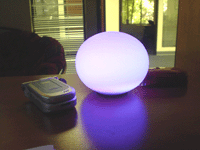
Then he saw an Ambient Orb. It's a groovy little ball that changes color in sync with incoming data -- growing more purple, for example, as your email inbox fills up or as the chance of rain increases. Martinez realized he could use Orbs to signal changes in electrical rates, programming them to glow green when the grid was underused -- and, thus, electricity cheaper -- and red during peak hours when customers were paying more for power. He bought 120 of them, handed them out to customers, and sat back to see what would happen.

Within weeks, Orb users reduced their peak-period energy use by 40 percent. Why? Because, Martinez explains, the glowing sphere was less annoying and more persistent than a text alert. "It's nonintrusive," he says. "It has a relatively benign effect. But when you suddenly see your ball flashing red, you notice."

Electricity is invisible. That's why we waste so much of it in the home -- leaving rechargers permanently plugged in and electronic devices idling in power-slurping "sleep" modes. We can't see that our houses account for nearly a quarter of the nation's energy appetite; we don't know when the grid is nearing capacity and expensive to use.

So Martinez hacked his customers' perceptual apparatuses. He made energy visible.

That's the power of "ambient information," which tries to combat data overload by moving information off computer screens and into the world around us. The Orb was originally sold as a tool for monitoring financial portfolios. You could set it to shine a serene sky blue when your stocks were going up or pulse an alarming red when they were tanking. Studies showed that people were two to three times more likely to actively manage their investments, selling off deadbeat stocks and buying better-performing ones, when they used the Orb. This is the psychological paradox of ambient information: We're more likely to act on a subtle but continuously present message than an intermittent one we're forced to stare at.

So here's the radical idea: Maybe the real killer app for ambient information isn't alleviating data overload or tracking investments. Maybe it's taming global warming. To improve energy efficiency and reduce emissions, we first need to make omnipresent the hidden facts about our usage -- paint them on the world around us.

After all, we already know we're energy hogs, right? We talk about our personal carbon footprint, argue the finer points of buying carbon credits, tut-tut over Al Gore's energy-bingeing McMansion. Ambient display of our actual usage might just get us to cut back.

There's already solid evidence that feedback mechanisms can change eco-behavior. Think about how hybrid-car owners become obsessed with the dashboard display showing an on-the-fly calculation of gas mileage. The result? They change the way they drive, specifically trying to maximize mileage. It becomes a game, an enjoyable challenge, complete with quantifiable personal bests.

Here's an even wilder idea: How about making our energy use visible to everyone? Imagine if your daily consumption were part of your Facebook page -- and broadcast to your friends by RSS feed. That would trigger what Ambient Devices CEO David Rose calls the sentinel effect: You'd work harder to conserve so you don't look like a jackass in front of your peers.

This isn't as far-fetched as it sounds. The design firm DIY Kyoto (as in Kyoto Protocol) recently began selling a device called the Wattson, which not only shows your energy usage but can also transmit the data to a Web site, letting you compare yourself with other Wattson users worldwide. In a Borg-like way, users can see how much they've collectively reduced their carbon impact.

The hope is that it could spawn a cascade of conservation. It's fun seeing your personal energy tab go down by kilowatts -- but just imagine watching the world's usage plunge by terawatts or petawatts. It would be like a global Prius, with millions worldwide tweaking the Earth for maximum mileage. Now that's fun.

Posted by Clive Thompson at 01:03 PM
August 24, 2007
Scientists engineer an out-of-body experience


This is insanely cool: A scientist hooked up some subjects to virtual-reality systems -- and hacked their brains into having an out-of-body experience.

The experiments were based on a long-known trick called the "rubber hand illusion." In this one, people hide one hand in their laps while looking at a rubber hand on the table in front of them. A researcher strokes the fake with a stick -- while simultaneously stroking the real hand in precisely the same way. Pretty soon the subject begins to identify so strongly with the rubber hand that if you smash it with a hammer, the subject will freak out and "feel" the pain.

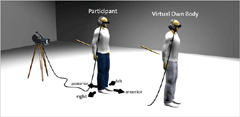
These next experiments went one step further. They involved scientists hooking up subjects with virtual-reality goggles that displayed a 3D copy of their own body, as seen from behind, in front of them. (Basically, if was as if they were standing behind themselves.) The scientists rubbed the back of the avatar with a stick while performing the same action on the real subject's body. Voila: The subjects began to identify with the avatar so strongly that they felt they avatar was their real body -- i.e. that they were floating incorporeally behind themselves.

This is, of course, precisely the sensation people report in out-of-body experiences. There's a story by Sandra Blakeslee in today's New York Times on the experiment, and I was surprised to learn that out-of-body experiences occur not just during near-death events and freaky meditation sessions, but sometimes during "extreme sports". Why? Possibly because any situation that screws up your proprioception badly enough can produce a dislocation of your sense of self. As Blakeslee writes:

The research reveals that "the sense of having a body, of being in a bodily self," is actually constructed from multiple sensory streams, said one expert on body and mind, Dr. Matthew M. Botvinick, an assistant professor of neuroscience at Princeton University.

Usually these sensory streams, which include vision, touch, balance and the sense of where one's body is positioned in space, work together seamlessly, Dr. Botvinick said. But when the information coming from the sensory sources does not match up, the sense of being embodied as a whole comes apart.

The brain, which abhors ambiguity, then forces a decision that can, as the new experiments show, involve the sense of being in a different body.

This makes me wonder: Have any video-game players identified so strongly with their onscreen avatars that they have a slightly out-of-body experience?

Here's one last delightful part to this story. The guy who conceived of the virtual-reality experiment? Here's how he came up with the idea:

Last year, when Dr. Ehrsson was "a bored medical student at University College London," he wondered, he said, "what would happen if you 'took' your eyes and moved them to a different part of a room."

"Would you see yourself where your eyes were placed?" he said. "Or from where your body was placed?"

I love the way scientific breakthroughs often come from hallucinogenically odd daydreaming. Researchers let their minds drift into super weird directions and ... boom! It's like how Einstein imagined himself riding on the crest of a beam of light, tried to envision what the world would look like, and came up with the theory of relativity.

Posted by Clive Thompson at 02:33 PM
August 23, 2007
Math proves the baseball season should be 256 games long


Many sports fans know that a short season leads to unfairness and chaos. The shorter the season of their favorite sport, the more likely it is that a comparatively weak team will ascend up the ladder -- merely by luckily winning a few key games.

So a couple of physicists recently decided to calculate precisely how long the major-league baseball seasons would need to last to be genuinely fair. They began with this assumption: To truly control for random outcomes -- for the slim chance that, in any given game, the lesser team will accidentally beat the better one -- you'd need to play a total of games equal to the cube of the teams involved. With 16 National League teams, that's 4096 games, and 2744 for the 14-team American League.

Of course, there ain't no way anyone's going to sit through that much baseball. So they decided to scale back the pursuit of perfection, and calculate how many games would result in a situation that was not perfect, but way more fair than the current system. Their number? A full 256 games -- much more than the 162 each team plays in the current National League season. As they put it in a press release:

By adding a preliminary round to the season, and eliminating the weakest teams before regular league play begins, the physicists showed that the best team in the National League would be virtually guaranteed to be among the top two or three teams with the best records, even with a significantly reduced number of games. Although the very best team may not always end up in the lead, a preliminary round or two would at least ensure that the top teams aren't eliminated from the playoffs through simple bad luck.

I confess I know so little about pro sports that I cannot even begin to figure out whether their assumptions hold water, but it seemed like a pretty fun little finding to me.
Posted by Clive Thompson at 02:20 PM
The pleasures of making a dungeon: My latest Wired News video-game column


Last week, Wired News published my latest video-game column, and it centers on topic I've long obsessed about: The relationship between architecture and the design of a good game -- or even the appreciation of a good game.

The piece is online here, and a copy is archived below:

The Subtle Pleasures of Building a Dungeon
by Clive Thompson

I've been stumping down this long, stony corridor for about five minutes, trying to reach a remote chamber where I'll battle a dread knight. But it's ponderously slow going, because there's too many twisty nooks -- which attract evil bats, so I'm forced to stop and fight every 20 seconds. So, like many RPG gamers, I start bitching: Who designed this place?

Ah, that's the problem. I did.

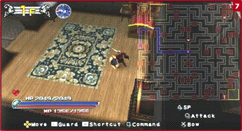
I was playing Dungeon Maker: Hunting Ground on my PSP. It's a fairly by-the-numbers role-playing game, with one twist: You create the dungeon yourself.

Basically, you build a small dungeon, then wander around in it in real time, killing any monsters that show up. You use the loot from your kills to build an even more tricked-out, phat dungeon -- which attracts ever more lethal and profitable monsters. This allows you to build an even bigger dungeon, attracting yet more monsters, etc., etc. It is, if you can dig this, a recursive dungeon crawler.

And it isn't enough merely to build your dungeon big. No, if you want to attract really top-flight monsters you need to understand their psychology, and even their aesthetics. Evil spirits and mongrels? They like twisty, winding passages. Intellectual Kobolds? They prefer book-lined studies, so they can get in a quiet evening of reading before you kill them. The gameplay quickly turns into a sort of Extreme Makeover of the damned. Before I knew it, I'd spent seven hours frantically rearranging furniture and building new wings.

Basically, if you strip away the ghouls and enchanted magikal attacks, it's a game about ... architecture.

Yet here's the thing: In a way, all games are. That's what "level design" is, after all: Architecture and landscape design. If you listen to gamers rave -- or complain -- about their latest title, half the time they're talking about what urban theorists would call the "built environment."

When we assess the multiplayer maps for Halo 3, we argue about whether there are enough nooks to hide inside, or sufficiently sneaky promontories from which to snipe. We whine about the monotonous corridor design in most RPGs. One of my only major complaints about Super Paper Mario was entirely architectural: The game forced you to ponderously double back every time you wanted to reach a save point.

Similarly, one of the biggest complaints about multiplayer world games is that they force you spend hours meandering around on foot to reach quest points that are, virtually, miles apart. (It's like playing golf, without a golf cart, eternally, in hell.) Why are online worlds created that way? It's intentional: The goal is to motivate newbies to "level up" high enough to get a mount they can ride around. The design exists purely to nudge our behavior in a certain direction. I understand the architectural intent, and I despise it.

Dungeon Maker, however, also managed to quell much of my whining, because it confronted me for the first time with how damn hard is it to build a good video-game dungeon. Sure, I tried to avoid tediously long corridor crawls. But every time I added another parlor room to lure another gibbering fiend, I inevitably added more complexity and more sprawl. Then I'd go into my creation and -- whoops -- my thumbs were numbed with the effort of schlepping from place to place.

By the time I'd crafted my fourth level, I had the surreal experience of revisiting my first level and literally being unable to remember why the hell I made the creative decisions I'd made. Stupid, stupid: Putting the staircase in the far northeast passage? What was I thinking? "Man," I thought as I lumbered down yet another passageway, "this dungeon blows."

Granted, there have been previous video games that included level-design as a core part of the play -- such as Neverwinter Nights, RPG Maker, or almost any moddable shooter. But these usually required a level of scripting geekery that I (and most average gamers) did not possess. Dungeon Maker makes it point-and-click easy.

I now wish that more RPGs offered DIY dungeon crafting -- because as I've discovered, architecture can be a weirdly enjoyable pastime. Dungeon Maker was fun, but not because of the actual fighting: The rote, button-mashing combat seemed practically to be an afterthought. No, the joy was entirely in building. It reminded me of when I was a kid and I'd sit around with graph paper, designing massive Dungeons & Dragons levels and imagining how badly I'd p0wn my friends. (It was more fun making them than playing them, really.)

The design theorist Christopher Alexander used to claim that all humans have an innate facility for architecture -- that everyone is capable of visualizing and imagining good living spaces. Looking at today's pop culture, where there are about 47 different reality TV shows devoted to home renovation, you could argue that he was right.

And did you ever wonder how The Sims became the world's top-selling game? It's not because people actually play it. Most players set up a couple of families and watch them evolve, but this quickly gets dull. Ah, but then Sims gamers discover the real game within the game. They learn about the cheats that give them infinite simoleans -- whereupon they begin joyfully building uninhabited monster homes, a pastime that accounts for the vast majority of the game's replayability.

Will Wright's genius wasn't in making a sim of human life. It was in making the world's easiest-to-use CAD tool. Apparently, there's a dungeonmaster in all of us -- just waiting to come out.

Posted by Clive Thompson at 02:09 PM
Preschoolers can engage in "metacognition"


Metacognition is the ability to be aware of your mental state -- to think about thinking. Historically, psychologists have assumed it's a pretty high-level process, which we can't really do until age five or so. Researchers would test preschoolers on their ability to assess their own mental state, and find that the kids couldn't.

But Simona Ghetti, assistant professor of psychology at UC Davis, recently wondered if the problem wasn't simply in the experiments. She noticed that most tests of metacognition asked the participants to use words to describe their internal states -- which, she theorized, is why little kids couldn't do it very well. The barrier was linguistic, not cognitive. So she devised a metacognition test that asked preschoolers instead to point to pictures to illustrate their internal state. Ghetti would pose the kids a question, and ask them to point to a picture of a confident-looking child if they were sure of the answer, or a doubtful-looking child if they weren't sure.

Bingo: The preschoolers apparently had no trouble identifying their internal state. As Ghetti put it:

The tests showed that young children are aware of their uncertainty in the moment. Even 3-year-olds pointed to the confident face when they correctly identified, for example, a drawing of a monkey that had some features removed to make it harder to recognize. They pointed to the doubtful face if they could not come up with a correct answer.

"Even 3-year-olds are more confident when they're right than when they're wrong," Ghetti said.

This experiment, of course, comes on the interesting work of the neuroscientist Jonathan Crystal, who this spring argued that even rats demonstrate metacognition. Again, his trick was simply in devising a more-clever way of scrutinizing rat thought processes.

Granted, either or both of these studies could prove to be flawed or ultimately misleading. But in general, they demonstrate the part of the scientific process that I always really love -- the ability of a new experimental protocol to unveil new information about the world. I write a lot about scientists, and I've grown to hugely admire the ones who are really good at devising elegant new experimental techniques.

Posted by Clive Thompson at 01:27 PM
August 22, 2007
Whale sleep


How do whales sleep? It's always been difficult to tell, because we can't easily observe their daily habits. But back in the late 90s, a female gray whale was rescued at sea and esconced at Sea World in San Diego, where a couple of scientists recorded its wake/sleep behavior for nine days solid. They wrote a paper with their observations in 1990 (PDF here).

The results? Well, it turns out that a busy day of sieve-feeding benthic crustaceans really knocks you out. The whale slept about 40% of the day, or about 9.5 hours. Also, the whale was diurnal, sleeping, like us, mostly at night.

Cool enough. But given those multiton brains they're carrying around, the really big question is: Do whales dream? The scientists recorded eye movement and neck-and-body jerks that suggested that indeed, "paradoxical sleep" -- REM -- might be going on. As they wrote ...

... we think that the presence of jerks during rest in the gray whale, taken together with our previous data on three species of dolphins, allows us to suggest that short episodes of PS do exist in Cetaceans in a modified form that is not accompanied by the classical polygraphical or behavioral signs of PS observed in most terrestrial mammals.

So, having duly cited the literature, we are now free to engage in the deliriously unscientific pastime of wondering: What in god's name are whales dreaming about? The underwater scenery? Prime numbers? The telepathic messages they're receiving from Alpha Centuri?

My favorite part of the paper is the diagrams showing the posture of the whale during sleep. Apparently she either floated slightly below the surface of the water, or chillaxed on the floor of the tank. Since this wasn't an in-the-wild observation, of course, it doesn't tell us whether or not whales would behave the same way in the briny deep, but perhaps future studies will explore this.


(Thanks to Science Blogs for this one!)

Posted by Clive Thompson at 02:33 PM
Why New Yorkers Last Longer: My latest feature in New York magazine


When I moved to New York nine years ago, my environment suddenly became much less healthy. On top of the nasty pollution, stress and overwork, my exercise evaporated: I had to give up my lifelong habit of daily cycling because the traffic is too psychotic. I figured I was probably shaving about five years off my life by moving here.

Whoops. It turns out that the Big Apple is actually good for you -- because New Yorkers now live longer than the American average, and what's more, life expectancy is rising faster here than in most of the rest of the US.

Why? That's what I tried to figure out in a story I published last week in New York magazine. It's online free, a copy is permanently archived below!

Why New Yorkers Last Longer
This city, once known as a capital of vice and self-destruction, is now a capital of longevity. What happened?
By Clive Thompson

Last winter, the New York City Department of Health released figures that told a surprising story: New Yorkers are living longer than ever, and longer than most people in the country. A New Yorker born in 2004 can now expect to live 78.6 years, nine months longer than the average American will. What's more, our life expectancy is increasing at a rate faster than that of most of the rest of the country. Since 1990, the average American has added only about two and a half years to his life, while we in New York have added 6.2 years to ours. In the year 2004 alone, our life expectancy shot up by five months -- a stunning leap, because American life spans normally increase by only a month or two each year. When these figures came out, urban-health experts were impressed and slightly dazed. It turns out the conventional wisdom is wrong: The city, it seems, won't kill you. Quite the opposite. Not only are we the safest big city in America, but we are, by this measure at least, the healthiest.
The "average life expectancy" of a city is a statistically curious number. It's not really a prediction about how long you're going to live. It's an average of how long everyone here lives -- and thus it forms a good barometer of the overall health of the city. In particular, a city's average life span is sensitive to the rates at which people die too young. Since the average New York life expectancy is now 78.6 years, anytime someone dies younger than that, it drags the city's overall average down slightly.

The math works like this. Imagine that one man dies of AIDS at age 25. Since he was statistically supposed to live to 78.6 years, he's died about 50 years too early, so he shaves 50 years off the city's overall pool of life. If one Wall Street guy collapses of a heart attack at age 65, he shaves only ten years off. You'd have to have five Wall Streeters die at that age to equal the impact of one AIDS victim. By the same logic, one infant's dying during childbirth -- 77.8 years too early -- is equal to ten people's succumbing to lung cancer at age 70. It is a very weird form of horse trading. The more you're able to prevent young people -- folks in their twenties and thirties -- from dying, the more rapidly you boost a city's overall life expectancy.

And this is precisely what the city has done, through a combination of smart public policy and sheer luck. All the boons of the nineties -- the aggressive policing, the dramatic drop in crime, the renaissance of the city's parks and street life, the freakish infusion of boom-time wealth -- played a part. Take the miraculous evaporation of the homicide rate. In 1990, a stunning 2,272 New Yorkers were murdered; in 2005, that number dropped to 579. Since a majority of those being killed were younger men, the reduced murder rate alone added tens of thousands of years to New York's life-expectancy pool. Another big drop was in HIV mortality rates. In 1994, deaths from AIDS peaked at over 7,100, but the arrival of better drugs and health care began to whittle that number by 80 percent -- so in 2005, only 1,419 died of AIDS. Again, the majority of the lives saved here were those of younger men, resulting in a disproportionately big upward leap in our city's life span. In 1989, the infant-mortality rate was 13.3 babies per 1,000, and by 2004, it had been halved, to 6.1, both because medical treatment improved and because alcohol and drug addictions eased. To top it off, drug-related deaths, another arena with disproportionately younger victims, tapered off, too.

Homicide, AIDS, and drugs are characteristically New York ways to die young, of course, so it's no surprise that when we sharply decreased the fatalities they caused, we caught up with the rest of the country. But here's the thing: It's not just that we've conquered these urban blights. Cancer and cardiac arrest are down, too. The number of people in the city dying from heart disease has dropped by a third in the last twenty years, and cancer rates have slid by nearly a fifth. And again in these cases, New York is getting healthier faster than the rest of the U.S.

In essence, there is a health gap emerging between our massive metropolis and the rest of the country -- some X factor that's improving our health in subtle, everyday ways. In fact, a back-of-the-envelope calculation shows that once you take out those uniquely New York ways to die -- AIDS, homicide, etc. -- we've still added at least 200,000 extra years onto the city's life-expectancy tables since 1980, making crucial advances in the same health areas the rest of the country struggles with. Like many New Yorkers, I'd moved here with some trepidation -- always figuring that the stress, pollution, and 60-hour workweeks would knock about five years off my life. I was wrong -- precisely wrong. But where, exactly, is our excess life coming from?


I TAKE THIS QUESTION TO THOMAS FRIEDEN, New York's commissioner of public health. Frieden is a wonk's wonk -- a handsome, energetic doctor who has gained a nationwide reputation for his aggressive effort to push New York's average-life-expectancy figure ever higher. The smoking ban of 2003? The trans-fat ban of last year? You can thank Frieden for both. These measures have already begun to lengthen life spans in the city. The smoking ban had an immediate effect: The number of deaths attributable to smoking has decreased from 8,960 in 2001 to 8,096 in 2005, a drop of 10 percent. Lung-cancer rates should begin to see the same effect a few decades from now, since it takes longer for the body to repair smoking-related lung damage.

But even Frieden admits that public policy can't account for all the gains. When I ask what the X factor is -- where the "excess life" is coming from -- Frieden goes over to his desk and returns with a clear plastic statuette. It's from the American Podiatric Medical Association and Prevention magazine: BEST WALKING CITY, 2006.

"We've won it a couple of years in a row," he tells me with a grin. He's got a bunch of them kicking around.

Walking? This isn't quite as facile an explanation as it sounds. Scientists who study urban health argue that it's not just that we walk more -- it's the way we walk that has a surprising spillover effect on life spans. Researchers have long known that people here walked fast -- far faster than anyone else in the country. Indeed, the easiest way to tell a New Yorker from an out-of-towner is by walking speed: The natives blast down the sidewalk at blitzkrieg pace, and the visitors mosey along like pack mules. Eleanor Simonsick, a Baltimore-based epidemiologist, knew that regular walking is a powerful way to maintain your health. But she began to wonder, a question very germane to us in New York: Does the speed at which you walk also affect your health?

She decided to conduct an experiment to find out. She and a group of scientists assembled 3,075 seniors in their seventies and asked them to traverse a 400-meter course, walking as fast as they could. They monitored their subjects' health over the next six years, during which time 430 of the geriatrics died and many more fell ill. When Simonsick crunched the data, she found that the ones who were dying and getting sick were the ones who walked the slowest. For every minute longer it took someone to complete the 400-meter walk, he had a 29 percent higher chance of mortality and a 52 percent greater chance of being disabled. People who walk faster live longer -- and enjoy better health in their later years.

"Walking speed absolutely reflects health status," Simonsick says. So when you irritatedly blow past a trio of ambling visitors from Ohio or Iowa on the subway platform, you're not just being an obnoxious New Yorker. You're demonstrating that you're going to outlive them -- and enjoy better health while they slowly degrade.

The thing is, as Simonsick points out, New York is literally designed to force people to walk, to climb stairs -- and to do it quickly. Driving in the city is maddening, pushing us onto the sidewalks and up and down the stairs to the subways. What's more, our social contract dictates that you should move your ass when you're on the sidewalk, so as not to annoy your fellow walkers. (A recent ranking of cities found that New York has the fastest pedestrians in the country.) As Simonsick sees it, the very structure of the city coerces us to exercise far more than people elsewhere in the U.S., in a way that is strongly correlated with a far-better life expectancy. Every city block doubles as a racewalking track, every subway station, a StairMaster. Seen this way, the whole city looks like a massive exercise machine dedicated to improving our health while we run errands.

This idea of the city as a health club is fairly revolutionary. Back in the beginning of the industrial revolution, cities were regarded, quite correctly, as lethal places to live. London and other newly ballooning industrial centers did not yet have sanitary or pollution laws, and the sudden influx of crammed-together citizens -- living cheek by jowl with smoke-belching factories downtown -- produced spectacular outbreaks of disease. Public-health experts somberly wrote about an "urban health penalty" -- the idea that cities were dark, satanic mills that inherently cut us down in the prime of life. In the first decades of the twentieth century, cities began to clean up their acts drastically, when sanitation standards emerged and inoculations began to aggressively squelch infectious diseases; the actual life spans in cities began to catch up to and exceed those of people in rural areas. But the idea of urban rot remained strong, so the cultural bias against urban life lived on. It didn't help when the seventies and eighties ushered in waves of urban crime, recession, and drug epidemics, and cities like New York and Detroit and Chicago sharply curtailed public-health services. Cities, more than ever, seemed like cesspools of dread and early death.

By 2000, though, the perspective looked altogether different. With a sharply reduced crime rate, runaway gentrification, and a geyser of boom-time dough, Manhattan had largely conquered the homicide, AIDS, and overdose problems that were pulling down the average life-expectancy figure. A trio of New York–based urban-health academics -- Nicholas Freudenberg, David Vlahov, and Sandro Galea, professors at Hunter College and the New York Academy of Medicine -- began to wonder if the "urban health penalty" still made sense. As they examined the most recent data about health in cities versus health in rural and suburban areas, they noticed that the cities were, contrary to theory, pulling ahead. This wasn't merely because cities tend to have richer citizens. In fact, they found that people are almost equally likely to be poor -- and to lack health insurance -- in urban and rural areas. Yet the percentage of rural people who ranked their health as "fair/poor" is much higher than in urban areas. And people are more likely to die young in the sticks: Death rates for 1-to-24-year-old males are 60 per 100,000 in cities, versus 80 in rural areas. Perhaps worst of all for the suburbs, obesity is rising far more rapidly than in cities.

"We were just walking around New York and thinking, Wait a minute," Vlahov says. "People in New York are in better shape than ever. So there's obviously got to be something about cities that's good for you."

The urban health penalty, they decided, had inverted itself. The new reality was that living in the suburbs and the country was the killer. In January 2005, Vlahov and his colleagues penned a manifesto they cleverly called "The Urban Health 'Advantage,'" and published it in the Journal of Urban Health. Cities, they posited, were now the healthiest places of all, because their environment conferred subtle advantages -- and guided its citizens, often quite unconsciously, to adopt healthier behaviors.


THREE YEARS AGO, LAWRENCE FRANK, a professor of urban planning at the University of British Columbia, set out to measure this effect, examining 10,858 people in Atlanta and the type of neighborhood they lived in. Some were in purely residential suburban neighborhoods, where you had to get in your car to buy a carton of milk; others lived in "mixed" downtown areas with shops within walking distance. When he checked the results, the health difference was shockingly large: A white man who lived in a more urban, mixed-use area was fully ten pounds lighter than a demographically identical guy who lived in a sprawling suburb.

"The more you drive, the more you weigh," Frank tells me after I call him to talk about it. He was unsurprised when I described New York's increases in life expectancy. "You put people in an environment where public transportation is rational and driving is almost impossible, and it would be shocking not to see this outcome," he says. Other scientists suggest that New York's benefits do not occur merely because the city is walkable. It's also because New York is old and filled with attractive architecture and interesting street scenes -- since, as it turns out, aesthetically pretty places lure people out of their homes and cars. A 2002 study by the National Institutes of Health found that people living in buildings built before 1973 were significantly more likely to walk one-mile distances than those living in areas with newer architecture -- because their environments were less architecturally ugly.

At the same time, New Yorkers are also more likely to visit parks than people who live in sprawl, because the parks are closer at hand. And proximity matters, as a study by Deborah Cohen, a senior natural scientist at the rand Corporation, discovered. When she examined the use of several parks in Los Angeles, she found that almost half the people using any given park lived no more than a quarter-mile away. In contrast, only 13 percent of the people using the park had come from more than a mile away. "The farther you are, the less willing you are to go to the park," she notes.

Interestingly, urban theorists believe it is not just the tightly packed nature of the city but also its social and economic density that has life-giving properties. When you're jammed, sardinelike, up against your neighbors, it's not hard to find a community of people who support you -- friends or ethnic peers -- and this strongly correlates with better health and a longer life. Then there are economies of scale: A big city has bigger hospitals that can afford better equipment -- the future of medicine arrives here first. We also tend to enjoy healthier food options, since demanding foodies (vegetarians and the like) are aggregated in one place, making it a mecca for farm-fresh produce and top-quality fish, chicken, and beef. There's also a richer cultural scene than in a small town, which helps keep people out and about and thus mentally stimulated.

Of course, the built environment wouldn't have done New Yorkers' health any good if it hadn't been catalyzed by the city's economic bonanza. The nineties were so lush they actually lifted some of the city's poorest out of poverty. But gentrification cut both ways. A more cynical -- and possibly clear-eyed -- explanation for New York's life-expectancy gains is that gentrification drove many of the city's poorest people out of town. Though no figures exist to accurately calculate it, what social scientists can measure is the effect of gentrification on the health of the poor who have stayed put: It turns out to be -- unexpectedly -- benevolent. One study by Ming Wen, a sociologist at the University of Utah, crunched data on 8,782 residents of various neighborhoods in Chicago. She expected to find the typical bleeding-heart conclusion: Poverty is bad, income inequality is bad, and the two together are worse yet. But in reality, income inequality at the neighborhood level paradoxically seemed to mitigate the bad effects of poverty. In neighborhoods that mixed affluent people alongside poor ones, the poorer residents were statistically healthier than those in non-mixed neighborhoods.

That's because, Wen concluded, the presence of relatively wealthy people has a spillover effect on the immediate neighborhood: safer streets, cleaner environments, better food in stores. (Indeed, another study found that poor teenagers in mixed-income neighborhoods ate more leafy green vegetables than poor teenagers in non-mixed ones.) Wen is careful not to say that all income equality produces trickle-down effects; if the poor and wealthy are completely sealed off from each other in different parts of a city, the effect doesn't occur.


AND THIS, AS IT TURNS OUT, helps explain the one troubling chapter in New York's life-expectancy success story: the Bronx. Alone among the five boroughs, the Bronx's average life expectancy has actually declined in the last twenty years. And it is the only one that saw very little financial uptick from the nineties boom years, and virtually no gentrification.

The effect on everyday health becomes pretty apparent to me when I take a trip up to St. Barnabas, the Bronx's largest acute-care hospital, to meet with Jerry Balentine and David Perlstein, the chief medical officer and associate medical director, respectively. They urge me to wander around a bit and look at the local bodegas, where the food options are pretty lousy -- mostly fatty canned foods and virtually no fresh vegetables. The new reality is, the Bronx is ballooning. "You walk along here and you almost never see an actual supermarket," Balentine says with a shrug. "So people can't eat healthily even if they want to. It's all fast food. That's what's cheap -- Chinese food, pizza."

Perlstein takes me for a stroll through one of St. Barnabas' clinics, and it's hardly a picture of good health. Virtually everyone is overweight, many enormously so: One white-haired woman poured over the edges of a small chair as she sat knitting; she looked as though she could easily crack 300 pounds. "This is our biggest problem," he says. There's an ethnic component; Hispanics tend to be stockier to begin with, he notes. But there's also a cognitive drift among his patients. Since they're surrounded all day long by people who are huge, they lose the ability to recognize what it means to be overweight. People who are healthy look creepily skinny.

"I get mothers coming in with their kids, and the kids are already looking a little too heavy, right?" Perlstein says. "But the mothers are going, 'He's not gaining enough weight! Give me a pill that makes him gain more weight!' They see being heavy as being healthy -- you're growing. It's completely the opposite of what people think in Manhattan."

Granted, New York is pushing various policies to affect the "food environment" in poorer areas of the city. In a pilot program in central Brooklyn, the South Bronx, and Harlem last winter, the city subsidized bodegas to carry one percent milk in addition to the unhealthier full-fat variant. And Frieden recently passed a law that will require most fast-food chains to prominently post the calorie content of their meals. But you can't get past the sheer difficulties of being broke. Perlstein has female patients who schedule mammograms but then skip them -- "because they've got three kids, and who's going to look after them while they're getting screened?"


AT TIMES, TALKING TO FRIEDEN and some of the other scientists, I wondered if all the talk about how healthy cities had become might be the latest species of boosterism, of civic mythmaking, partly because he's staked his legacy on such aggressive policies as bad-food bans. And urban theorists have begun a fierce beat-down on the suburbs, castigating them endlessly for being the epicenter of the obesity epidemic. As it happens, this is the argument of Matthew Turner, an economist at the University of Toronto. Last year, he decided he was a bit sick of hearing about the health benefits of cities. The "urban health advantage" sounded to him like mere self-congratulation -- the skinny, attractive folks in the megalopolises crowing about their innate superiority, and recoiling at the barbarisms of the SUV-driving, Wal-Mart-shopping exurban masses. It seemed too much like blue-state snobbery. So Turner devised a new experiment to test the power of the urban health advantage.

If it's true that cities impose inherently healthier behavior on you, Turner reasoned, then people who move from cities to suburbs should get fatter -- and vice versa. He began hoovering up data on 6,000 young Americans in their twenties to forties, tracking where they lived over a six-year period. He used satellite imagery and tallies of shops and churches to determine the level of sprawl in each subject's neighborhood, then gathered information on each one's weight.

When he examined the data, he discovered something surprising: People who moved between dense and sprawling neighborhoods didn't change weight. Despite the claims of the new urbanists, Turner saw no evidence that one's built environment has an impact on one's health. "This idea that the built environment affects how much you weigh," he told me, "is just wrong."

But then why do cities harbor slimmer people who live longer and healthier than those in sprawl? Because, Turner argues, the populations are self-selecting. Highly active people who don't like to drive -- and who crave to make boatloads of money -- naturally gravitate to places like New York, because that suits their chosen lifestyle. If we walk a lot here, it's because we're drawn to cities that force us to do so. The converse is also true: People who are heavier and less fit gravitate to suburbs precisely because that's where they won't need to walk -- where nothing is possible without getting in a car. (Mind you, Turner's rival scientists are not convinced by his argument. As one pointed out to me, moving to a differently dense area might take years to change your weight -- longer than Turner's time frame.) In Turner's view, the logic of the urban health advantage is not only wrong, it's backward. It's not that New York makes us healthier. We make it healthier, by flocking here to live.

Ultimately, I've come to believe that Turner is likely correct -- but so are the proponents of the urban health advantage. The two theories are not mutually exclusive. A city can be good for your health and, at the same time, attract healthy people.

The life-span miracle in New York -- the X factor I've been searching for -- is not one single cause, but a feedback loop. There's no doubt that when New York cleaned up its crime in the nineties, it coasted to health as well as wealth in the high-tech boom: Wealthier people always live longer. But prosperity also wrought a cultural shift. New York once again became the city for young, ambitious strivers -- precisely the sort that demand the cutting edge of healthy-living perks: an organic-food store on every corner, a yoga studio down the block, unreasonable amounts of sushi, clean parks in which to jog.

In a sense, the life-expectancy revolution challenges one of New Yorkers' longest-held and oddly cherished self-mythologies: that our kinetic, aggressive city is a grim physical challenge, and we're the Darwinian winners of the American race merely for surviving the mean streets. The truth is that the dystopic, self-destructive seventies are as gone as the days of the Bowery Boys.

Health has become our new urban stereotype. If New York City were still a raw, ungovernable failure, Frieden's invasive nanny-state laws like banning smoking in bars or trans-fats would have made him a laughingstock. But the new New York has come to expect such measures; we probably even take a masochistic joy in being forced to behave ourselves. Hey, we'd been looking for an excuse to quit smoking anyway! And trans-fats -- well, everyone knows that stuff'll kill you, right? This is why Frieden will likely have no problem slapping another 50 cents onto the taxes for a pack of cigarettes this fall, either.

The urban health advantage is here, all right. And it is us.

Posted by Clive Thompson at 02:16 PM
Surrrealist video game


One of the things I loved about early 80s video games is how incredibly weird they were. Half-eaten yellow pizzas being chased around by ghosts? Trampoline-enabled police mice pursued by cats? A plumber, hunting and killing the ape who stole his princess girlfriend? Ahem.

So for years, I always wished some game designer would just rip the lid off and finally make a game that was straightforwardly surrealistic -- where cause and effect had only a very inscrutable relationship to one another. Like maybe the control scheme keeps switching unpredictably, or your character transforms for no good reason at random intervals.

Le voila. Today I happened upon game, game, and again game, a superstrange creation by Jason Nelson, and it pretty much satisfies all my criteria. The game, as Nelson describes it, is ...

... a digital poem/game/net artwork hybrid of sorts. There are 13 curious levels filled with poetics, hand drawn creatures, scribbles, backgrounds and other poorly made bigts. The theme (cringe) hovers around our many failed/error filled/compelling belief systems, from consumerism to monotheism.

Gameplaywise, it involves you piloting a small blob around various delightfully pen-scribbled scenes. You've got goals ... sort of. And destinations ... sort of. When you bump into things, it does ... uh ... something, including triggering trippy sound samples, text boxes, transformations of the screen, and archaic pop-up home video. Oddly mesmerizing!

Posted by Clive Thompson at 01:49 PM
The Making of Halo 3: My latest feature for Wired magazine


In the spring, Wired asked me to visit Bungie -- the company that makes the insanely popular Halo series of video games -- and report on the making of Halo 3, their latest sequel, due out next month. The story is in the current issue, and it focuses mostly on the company's crazily data-oriented mechanism for testing the game to see how fun and playable it is.

The full piece is currently online at Wired's site, and a permanent archived copy is below, but hey! Why not rush out right now and buy the print copy too?

Halo 3: How Microsoft Labs Invented a New Science of Play
3,000 hours of testing, a one-way mirror, and a team of designers obsessed with finding the golden mean of play
by Clive Thompson

Sitting in an office chair and frowning slightly, Randy Pagulayan peers through a one-way mirror. The scene on the other side looks like the game room in a typical suburban house: There's a large flat-panel TV hooked up to an Xbox 360, and a 34-year-old woman is sprawled in a comfy chair, blasting away at huge Sasquatchian aliens. It's June, and the woman is among the luckier geeks on the planet. She's playing Halo 3, the latest sequel to one of the most innovative and beloved videogames of all time, months before its September 25 release.

The designers at Bungie Studios, creators of the Halo series, have been tweaking this installment for the past three years. Now it's crunch time, and they need to know: Does Halo 3 rock?

"Is the game fun?" whispers Pagulayan, a compact Filipino man with a long goatee and architect-chic glasses, as we watch the player in the adjacent room. "Do people enjoy it, do they get a sense of speed and purpose?" To answer these questions, Pagulayan runs a testing lab for Bungie that looks more like a psychological research institute than a game studio. The room we're monitoring is wired with video cameras that Pagulayan can swivel around to record the player's expressions or see which buttons they're pressing on the controller. Every moment of onscreen action is being digitally recorded.

Midway through the first level, his test subject stumbles into an area cluttered with boxes, where aliens -- chattering little Grunts and howling, towering Brutes -- quickly surround her. She's butchered in about 15 seconds. She keeps plowing back into the same battle but gets killed over and over again.

"Here's the problem," Pagulayan mutters, motioning to a computer monitor that shows us the game from the player's perspective. He points to a bunch of grenades lying on the ground. She ought to be picking those up and using them, he says, but the grenades aren't visible enough. "There's a million of them, but she just missed them, dammit. She charged right in." He shakes his head. "That's not acceptable."

Pagulayan makes a note of the problem. It is his job to find flaws in Halo 3 that its creators, who know what players should do, might not be able to see. He assesses whether the aliens have gotten too lethal, whether the revamped Needler guns are powerful enough, and -- most important -- if and when players are getting bored or (as is more often the case) frustrated. Clicking away on his keyboard, Pagulayan brings up video of one of the first fights in the game, in which a Brute wields a ferocious gun. Neophyte players are getting massacred.

"That enemy can kill the player in three shots," he says. "Imagine your mother playing, where she's barely learning how to move around in the game -- bam, bam, bam -- dead. That's not going to be a fun experience."

All game companies test their products, but generally they just pay people to report any bugs they find -- monsters that disappear or places where graphics don't render properly. But because it is owned by Microsoft, which launches dozens of Xbox and PC games every year, Bungie has access to one of the most advanced game-testing facilities ever built. Pagulayan and his team have now analyzed more than 3,000 hours of Halo 3 played by some 600 everyday gamers, tracking everything from favored weapons to how and where -- down to the square foot -- players most frequently get killed.

Bungie doesn't just test its own games this way. It also buys copies of rival titles and studies those, too, to see how Halo matches up. "I've never seen anything like it," says Ian Bogost, a professor of digital media at Georgia Tech, who toured the testing lab in the fall. "The system they've got is insane."

It might seem like an awfully clinical approach to creating an epic space-war adventure. But Bungie's designers aren't just making a game: They're trying to divine the golden mean of fun. They need to create an experience that is challenging enough to thrill the 15 million existing hardcore fans of Halo -- yet appealing enough to lure in millions of new players.

If anyone can pull off this delicate balance, it's Bungie. Released in 2001, the original Halo seamlessly blended riveting gameplay with a cinematic narrative -- the fight between humans and a murderous alien race was told through plenty of twitchy, white- knuckled combat. When Halo 2 debuted three years later, it again broke new ground by letting gamers square off against their friends on the fledgling Xbox Live online service. Fans went berserk. They debated the intricate plotlines, bought T-shirts and figurines, read Halo novels that Bungie produced, and crawled into work bleary-eyed after all-night death matches. Halo became a cultural touchstone, a Star Wars for the thumbstick generation.

Now the company has to do it again, only better. This will be the first Halo for the Xbox 360, and it comes at a critical point in the console wars, with Microsoft fighting both Sony's graphically superior PlayStation 3 and Nintendo's unexpected hit, the wrist-twisting Wii. Microsoft needs Halo 3 to be a system seller -- a game so good that people buy an Xbox 360 just to play it (the original Xbox's only profitable quarter came during the launch of Halo 2). "I don't see any other game that's going to have as big a blast radius for the Xbox as Halo 3," says Dean Takahashi, author of The Xbox 360 Uncloaked. "They need to sell a lot of consoles for Microsoft."

So Bungie's designers sift through Pagulayan's reports, peer through the one-way mirror, and scrutinize every second of the game. Videogame development involves artistry, obviously. But at Bungie Studios, it's become something of a science as well.


BUNGIE'S OFFICE IN KIRKLAND, WASHINGTON, houses more than 100 workers in a massive open room covered by a domed roof. It's early June, and the place has an air of quiet, frantic energy. In a far corner, a group of artists work on crafting the swoopy attack movements of the aliens. Along a wall, environment programmers stare intently at screens, fine-tuning scenery in the latest levels. Marty O'Donnell, the company's audio engineer, is holed up in a soundproof studio room, tweaking Halo 3's 34,000-plus lines of combat dialog, to ensure that aliens and marines curse and yell appropriately during battles (Wired's editor in chief, Chris Anderson, voiced a few blood-curdling screams for the game). Near the kitchen area, a programmer naps in a small pile of beanbag chairs.

Now one of the largest game design studios in the industry, Bungie began as a two-person operation. In 1991, college pals Alex Seropian and Jason Jones gathered in Jones' Chicago basement to create games for the Macintosh. Their first hit, in 1994, was a first- person shooter called Marathon. Most shoot-'em-ups of that time, like Doom and Wolfenstein 3D, had little or no plot; finishing a mission was as simple as fighting your way to the end. But Seropian and Jones imbued their games with intricate story lines and vibrant characters. Marathon and its sequels also pioneered technical advances astonishing for the era. Two gamers could team up and play the game in cooperative mode, while up to eight players could spar against one another in virtual arenas, taunting opponents over AppleTalk.

With the Marathon franchise and another game called Myth, Bungie built a loyal cult following. In the late-'90s, the designers started planning a new strategy-based title in which players would control an entire army of space marines fighting a rival band of hyperactive, gibbering aliens. The action would involve moving entire military battalions around the battlefield at once, and players would engage in a sort of futuristic version of Risk. But as work on the project began, the team found itself drawn back to the first-person, kill-frenzy action of Marathon. Eventually they decided their new game would focus not on the whole army but on a single soldier -- Master Chief -- as he fought the Covenant, a race of aliens driven by a mysterious religious prophesy. Halo was born.

Early on, the Bungie crew came up with a mantra that would eventually guide all aspects of Halo gameplay: "30 seconds of fun." The idea was to have Halo repeatedly immerse players in hectic battles that would last for half a minute -- just long enough to create heart-thumping chaos and the risk of death -- before offering a respite. Meanwhile, each level would also include scripted cinematic scenes to push the story forward. It was a subtle but deeply pleasing balancing act: Halo neither bored people with overly long storytelling animations nor numbed them with pointless fighting.

When Bungie demo'd the game at Macworld Expo in 1999, fans were awestruck. So were Microsoft game executives. They were looking for a system seller for their forthcoming Xbox and for the Xbox Live online service they hoped to launch shortly thereafter. Microsoft bought Bungie in 2000 for a reported $50 million; a year later, Halo, recoded for Microsoft's console, became the must-have game of the year. It instantly transformed the Xbox from a dubious proposition to a credible alternative to the then-dominant PlayStation 2. Bill Gates and CEO Steve Ballmer began pushing hard for a sequel.

The pressure to deliver nearly destroyed Bungie. When it began making the original Halo, the design team consisted of 10 people. They could all sit in a single room and communicate by yelling over their shoulders or peering at each other's cool creations onscreen. To make Halo 2, the company ballooned to more than 60. Separate teams formed to design each level of the game, but they didn't coordinate their efforts: When project leaders assembled the pieces for the first time, they discovered that the story was incomprehensible and the game whipsawed from too easy to nearly impossible.

"It was a disaster in the game-story campaign," admits Harold Ryan, the studio manager. "We looked around the room going, 'I don't want to play this. I don't want to make this.'" They threw out 80 percent of the work they'd done and started over. But they now had barely a year and a half to reconstruct the entire game.

Luckily, Bungie had a secret weapon. Because games were becoming a new focus for Microsoft, the company had built a dedicated usability lab for stress-testing its titles. Bungie tapped Pagulayan, a recent PhD graduate in experimental psychology from the University of Cincinnati, to refine Halo 2 in the facility. Pagulayan's team quickly went to work building tools for extracting gameplay data, including the location of each player and when and where they fired weapons, rode vehicles, killed aliens, and died. They ran weekly tests, analyzing 2,300 hours of play by 400 gamers in under two months. Over and over again, they found snags -- a mutant alien that was far too powerful, a lava pit that too many players fell into.

But the time constraints were daunting, and the lab wasn't able to catch everything. In the end, Halo 2 was a less complex, less satisfying game than the first Halo. In the original, players had three equally powerful ways to attack: gun, grenade, or punch attack -- the "golden tripod," as Jamie Griesemer, Bungie's head of gameplay design, dubbed it. Like a game of rock-paper-scissors, part of the fun was frantically deciding which method would work best. But in Halo 2, the designers decided to let players wield two guns, an option so overpowering that players rarely used any other form of attack. Perhaps worst of all, Bungie's team didn't have time to finish their story. Halo 2 ended with Master Chief announcing that he's returning to Earth and "finishing this fight" against the alien force. Then... nothing. The credits roll. It was as if the coders had simply turned off their computers and walked away. In public, Bungie employees put on a brave face, but privately they were chagrined. "Just as the game was going out the door, everybody was kind of like, Holy shit -- this is not what we like here," recalls Brian Jarrard, Bungie's head of community relations.

One aspect of Halo 2 did blow everyone away: multiplayer matches over the Internet. No console game had yet mastered online play. And Bungie worked closely with the engineers at Microsoft's Xbox Live service to make signing on point-and-click simple. In minutes, Halo 2 players could join a quick game of "death match" -- kill others before they kill you -- or assemble teams for rollicking bouts of capture the flag. Better yet, players were automatically paired with others at the same skill level, ensuring that they wouldn't be instantly slaughtered by crazily adept 12-year-olds in Texas.

Fans swarmed online. Halo 2 became a system seller again: Of the 6 million people who have signed up for Xbox Live, fully two-thirds of them joined to play Halo. Redmond was ecstatic. Online gaming had long been considered a vital next step for console makers and, thanks to Bungie, Microsoft got there first.


AS I PEER OVER HIS SHOULDER at the computer screen, Tom Doyle prepares to show off his new gun. Holding an Xbox controller, he walks Master Chief over to a menacing, garbage-can-sized weapon and cradles it in both arms. Doyle spins the in-game camera around, so that we're staring right down the barrel, and fires. A stream of white-blue plasma pours out. This is the Plasma Turret -- a powerful alien weapon debuting in Halo 3 that can blast through your shield in about two seconds. Doyle designed it.

"A lot of the energy weapons in Halo 2 felt frail, like pyoo-pyoo-pyoo Buck Rogers lasers" he says. It made people not want to pick them up and use them. "This feels more deadly. You can almost feel the heat of the weapon, the ignited plasma beams." He chuckles. "You know this thing is gonna kill."

Bungie is determined not to repeat the mistakes of Halo 2. This time it wants to make the single-player game perfect. To this end, it has committed to a two-step process: First dream up the new weapons, levels, and situations. Then monitor hundreds of people as they play the hell out of them in Pagulayan's lab.

There are a few things to fix right away. One of Bungie's central goals is to restore the "golden tripod" of play. Working with Doyle and the other weapons artists, gameplay chief Griesemer tweaked the guns -- for example, reducing the amount of ammo many carried -- so that wielding two at a time won't always be the most effective way to dispatch an enemy. He then boosted the power of grenades and the "melee" punching attacks. Battles, he hopes, will once again become the sort of lightning-fast chess matches they were in the original Halo, requiring constant, on-the-fly decisions about which method of attack to use.

To make combat even more unpredictable -- and to give longtime Halo players new treats -- Griesemer and the team devised new objects for the game, doubling the number of weapons. Inspired by a real-life, high-powered beam called a Galilean laser, Doyle invented the Spartan Laser. It produces a bolt that can destroy an enemy in one shot -- but because it takes a few seconds to charge, it gives astute opponents the chance to notice they're being targeted. Other designers came up with the Bubble Shield, a temporary force field, and the Gravity Lift, which players can use to propel themselves into the air. Among the new vehicles is the Mongoose, a small four-wheeled motorcycle, and the Brute Chopper, a sort of high tech Big Wheel with a ferocious cannon mounted in front. Each new addition, Griesemer points out, brings new facets to the gameplay. But each also inevitably causes unexpected problems: A particular gun becomes too powerful, a vehicle ends up making battles lopsided -- and suddenly the game is less fun.

This is where Pagulayan and two assistant Bungie researchers step in. Every other week, beginning in the fall of 2006 -- when the first builds of Halo 3 were available for testing -- Pagulayan and his team have recruited about 20 people to come into the lab and play the game. Some tests include a pop-up box that interrupts the player every few minutes, asking them to rate how engaged, interested, or frustrated they are. Pagulayan also has gamers talk out loud about what they're experiencing, providing a stream-of-consciousness record of their thought process as they play. Over time, he's gathered voluminous stats on player locations, weapons, and vehicles.

After each session Pagulayan analyzes the data for patterns that he can report to Bungie. For example, he produces snapshots of where players are located in the game at various points in time -- five minutes in, one hour in, eight hours in -- to show how they are advancing. If they're going too fast, the game might be too easy; too slow, and it might be too hard. He can also generate a map showing where people are dying, to identify any topographical features that might be making a battle onerous. And he can produce charts that detail how players died, which might indicate that a particular alien or gun is proving unexpectedly lethal or wankishly impotent.

The lab also records video footage of every testing session and hyperlinks these clips to the individual progress reports. If the design team wonders why players are having trouble in a particular area, they can just pull up a few test games to see what's going wrong. Take what happened last March: A report noted an unusual number of "suicides" among players piloting the alien Wraith tank in an upper level. After watching dozens of archived test games, Griesemer spotted the problem. The players were firing the tank's gun when its turret was pointed toward the ground, attempting to wipe out nearby attackers. But the explosion ended up also killing (and frustrating) the player. To prevent this, Griesemer reprogrammed the tank so that the turret couldn't be lowered beyond a certain point. The Wraith suicides stopped.

A similar report showed that in the game's first level, called Jungle, players often ran out of rounds for their rifles. This was a mystery, because the designers had been careful to leave more than enough ammunition lying around. The team checked Pagulayan's video records and found that people were firing at the aliens when they were too far away, misjudging the range of the weapon and wasting bullets.

At first the designers couldn't figure out how to fix this problem. But then Griesemer stumbled on an elegant hack: He made the targeting reticule turn red when enemies were in range, subtly communicating to players when their shots were likely to hit home. It worked.

The ideal in gameplay, the goal every developer aims for, is an experience that keeps players in a "flow" state -- constantly surfing the edges of their abilities without bogging down. Modern videogames are often compared to Hollywood movies, but the comparison, many Bungie designers will tell you, is inaccurate. A movie is static. "You sit there and absorb it all in a single two-hour shot, and it's perfectly linear," says Frank O'Connor, one of the writers tasked with scripting the story line in Halo 3.

Creating a game, in contrast, is like a combination of architecture -- constructing environments that influence the behavior of people inside them -- and designing a new sport. Gamemakers have to devise a system of rules and equipment that gives players a few basic goals and then allows them to find their own ways of achieving those goals. The flow comes from constantly discovering innovative ways to solve these open-ended problems.

Of course, this means that players will sometimes surprise game designers by doing things even they never thought of. This spring, executive producer Jonty Barnes watched a tester run around in a multiplayer level of Halo 3 that's constructed like a deep canyon. A bunch of Gravity Lifts were scattered around the bottom, and the player was bouncing from one to another. Then the tester got a clever idea: He grabbed one lift and, holding it, jumped into another one, launching himself up onto a high ledge. He then placed the second lift on the ledge and used it to bounce up even higher, landing on the top rim of the canyon. That area wasn't even supposed to be accessible to players.

"So he's up running on the canyon ledge, and the engineers are going, 'Christ, how the hell did that happen? Do you know what kind of bugs this is going to cause?'" Barnes laughs, a hint of pride in his voice. "But that's what you get when you set people free in your world."

HALO 3 IS A VIBRANT, BEAUTIFUL GAME, BUT it's also a bit cartoony. It doesn't have the eye-popping verisimilitude of, say, Gears of War, a rival Xbox 360 hit from Epic Games that dazzled fans last winter. Many critics have made this same comparison, and it's a sore point among some Bungie designers. They like to note that Gears of War -- like most of today's shooters -- takes place mostly in narrow corridors with only a few enemies at a time, so its makers can lavish attention on every square foot of space. Halo 3 is set in sprawling outdoor levels, with dozens of alien enemies swarming onscreen at once. The vastness of the game's geography means that gamers can replay each battle several times, trying several radically different ways to fight through it. It also means that Bungie's designers have to spread the Xbox 360's processing power around more thinly.

But though expansive levels may be one of the keys to Halo's appeal, the problems they cause go well beyond graphics. Enormous battlefields also create lots of places where things can go wrong -- areas where players can get bored, stuck, or killed. This has been one of the main challenges facing Halo 3's designers; it first showed up in testing of the beginning Jungle level. Players were simply baffled about where to go.

In the lab, Pagulayan pulls up an early map of Jungle; on it are superimposed the locations of about 30 testers after half an hour of play. The dots are scattered throughout the terrain. This, he says, is bad: It means that people were wandering aimlessly instead of progressing through the level. "People were lost," Pagulayan says. "There wasn't much deep analysis to do here."

To solve such problems, the designers must subtly direct player movement by altering the world in small ways. In this case, they decided to change the geography of the Jungle level so that in certain places players had to jump down a steep ledge to reach the next area. This way people can't go backward, because they can't climb back up the ledges. Pagulayan shows me a map from the next testing round, after the fix was implemented -- and sure enough, all the dots are clustered in tight bunches, right where they are supposed to be.

Another case of terrain-sprawl trouble popped up a few months later in one of the upper levels. The level is intended to introduce vehicle combat, with players following a bunch of their fellow marines as they clamber aboard Warthog ATVs and ride out over a wide-open plain. But Pagulayan's data showed that a significant number of players were trudging across the plain on foot. It turns out the designers hadn't put enough vehicles in the scene, and the artificial-intelligence marines were taking them all before players realized they were supposed to hop aboard. The solution: More Warthogs.


ON A SUNNY THURSDAY AFTERNOON, I'm finally allowed my own taste of Halo 3. I'm escorted into the faux game room, seated in the comfy chair, and handed a controller. I'll be playing the Jungle mission. Pagulayan settles behind the one-way mirror to observe.

As I wander through the lush forest, I'm struck by details: Steam rising off felled logs, clusters of insects flying in clouds, plants that sway realistically as I brush past them. Halo 3 may not have the most advanced graphics available, but it's noticeably more gorgeous than the previous Halo games. Soon, though, I get confused; I try to follow one of my comrades up a short cliff, but I can't scale it. It takes me five minutes to figure out that I'm supposed to go around instead.

Then, bang -- the action starts. A phalanx of Grunts comes squealing to attack, and soon I'm wearing out my trigger finger as I blast away with my machine gun. Sure enough, the "golden tripod" balance has been restored. The guns seem to run out of ammunition more quickly than usual, so I'm constantly opting for punching attacks and, later, grenades to take down large groups of enemies. It takes me a while to figure out which button controls my melee attack -- where my avatar runs up and smashes an opponent in the head -- but once I get it right, I discover that it's enormously satisfying: Each blow delivers a moist, brutal impact that sends foes flying.

After half an hour, Pagulayan pulls me out of the room for a debriefing. I'd been temporarily flummoxed at the cliff, he observes. "We've had participants spend 30 minutes trying to climb up there." He thinks the designers will need to make it easier, maybe adding a little arrow to show the correct route. He also picked up my confusion over the melee attack button. Other testers are having the same problem, and Bungie is not yet sure how to fix it.

Pagulayan makes notes on my experience -- more data to feed into the Bungie machine. They'll crack these problems, he is sure. They'll solve the mystery of why some Brutes are going AWOL in a later Jungle battle. They'll train their AI marines so they don't keep mindlessly hollering the same curses over and over while fighting. And they'll figure out how to get players to monitor their ammo -- before they run out and get gunned down.

Last week 52 percent of players gave the Jungle level a 5 out of 5 rating for "fun," and another 40 percent rated it a 4.

Pagulayan wants to do better.

Posted by Clive Thompson at 01:19 PM
Cities increase the power of thunderstorms by 30 per cent


Two weeks ago, we got drowned here in New York when a flash storm dumped three inches of rain on the city. It doesn't sound like much, but considering that about 13 million gallons of water flood into the subway on a completely bone-dry sunny day, the additional gallons totally b0rked the system -- and the trains ground to a halt, which meant New York ground to a halt.

So I was intrigued to happen upon a recent study claiming that cities actually increase the intensity of storms. Two Princeton engineers gathered a boatload of data about a humongous storm that slammed Baltimore in July 2004, looking at lightning strikes, rainfall, clouds and aerosols. Their conclusion? The structure of the city exacerbated the storm -- producing 30 per cent more rainfall than had the storm passed over a piece of nearby non-urban countryside. As they noted in a press release:

Much of the lightning during the 2004 storm wrapped around the western edges of Baltimore and Washington, D.C., to the south. "It's as if all of a sudden the lightning can 'feel' the city."

Sentient thunderstorms. I love it. Run for your lives!!

Seriously, though, they hypothesize that there's a bouquet of urban-design-related vectors at play here, including the "urban heat island effect", which adds energy to a thunderstorm, as well as tall buildings that increase wind drag and provide "boiling action" that boosts rainfall. Pollution, they think, might also increase the yield.

Posted by Clive Thompson at 12:50 PM
I see dead blogs

Well, this blog, anyway. Let's see, my last post was on -- what -- May 9? Or more precisely, Stardate -316352.05, according to this converter.

Things have been, ahem, a tad hectic in my work life in the last three months, hence the radio silence. However, I have since repowered the shields and located a fresh dilithium crystal on Ebay, so it's all good now.

Posted by Clive Thompson at 12:41 PM